


Episode Transcript
Marguerite Martin interviews Laura Svancarek Move to Tacoma Podcast
===
Marguerite Martin: [00:00:00] This is Channel 253.
Producer Doug Mackey: Move to Tacoma. On this episode of Move to Tacoma.
Laura Svancarek: Having better options, it doesn’t mean that you have to not own any cars as a household. Mm-hmm. But it gives you the freedom to be able to choose to not have a car at all or to have one fewer car per your household. Yes. So the, the statistic is that it costs about $11,000 per year to own a car, um, and that’s, that’s a lot of money.
That feels so low, though. Right?
Marguerite Martin: That feels so low.
Producer Doug Mackey: Channel 253 is member-supported. I’m producer Doug Mackey, and I hope you will show your support by going to channel253.com/membership and join. Thank you. We’re back.
Marguerite Martin: I’m Marguerite, and I want you to move to Tacoma.
Producer Doug Mackey: Move to Tacoma. Move to Tacoma. Move to Tacoma.
Marguerite Martin: You’ll like it.
Producer Doug Mackey: Move to Tacoma. Move to Tacoma.
Laura Svancarek: MoveToTacoma.com.
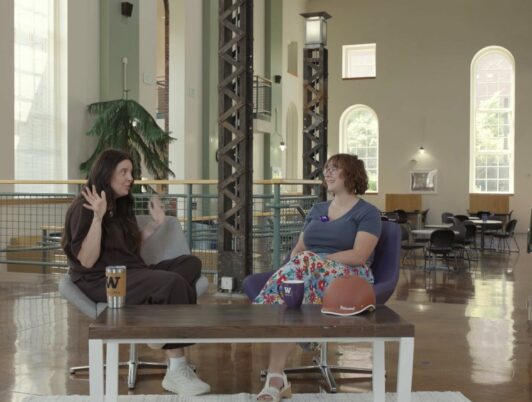
Marguerite Martin: Hi, I’m Marguerite, and this is [00:01:00] Move to Tacoma, and I’m here today with Laura Svancarek, the executive director of Tacoma On the Go. Welcome, Laura.
Laura Svancarek: Yeah, so happy to be here.
Marguerite Martin: We had your predecessor on as our, I think, second podcast guest ever, and but back then it was Taco- uh, it was, what, Downtown On the Go.
Laura Svancarek: Downtown On the Go, yes.
Marguerite Martin: So why was the change made from Downtown On the Go to Tacoma On the Go?
Laura Svancarek: Yeah, absolutely. So our organization was originally started as a program of the Chamber of Commerce, uh, with the purpose to focus on, uh, downtown employers, employees, and residents. So helping folks with their commutes, helping with activations in the downtown area.
Very much focused on that downtown Tacoma, getting to downtown Tacoma, staying in downtown Tacoma. Mm-hmm. Over time, uh, our work has expanded quite a bit outside of the downtown corridor. Part of that conversation is, well, people do live in downtown, but a lot of folks who live down- or who work downtown live in other places, so how [00:02:00] are they getting to downtown?
Um, but also, you know, we do transportation advocacy work, and when you look at where there are gaps in infrastructure, at this point it’s not necessarily downtown.
Marguerite Martin: Yeah.
Laura Svancarek: There’s a lot of need, uh, for improved infrastructure in the east side, in South Tacoma, in the South End, and this is a result of, you know, decades and decades of intentional disinvestment in- Yeah
communities of color, um, that now the city is trying to work to address. But we’re left in this infrastructure deficit. And so it became clear that we were spending more time outside of downtown, and the name became confusing.
Marguerite Martin: Oh, yeah.
Laura Svancarek: People wouldn’t reach out to us because they were concerned about something that wasn’t in downtown specifically.
Mm-hmm. Um, so we changed the name, uh, just under a year ago at our fundraiser last year to Tacoma On The Go to reflect that commitment, um, to safe mobility for all, for everyone in our city. I love that. So all of Tacoma.
Marguerite Martin: Yes. I love it. Okay. Well, [00:03:00] Laura, when did you move to Tacoma and why?
Laura Svancarek: I moved to Tacoma in 2018.
Uh, I had been living out on the Key Peninsula for a number of years. Okay. Fun fact. I was working in environmental education, so, um, I’m sure, uh, listeners are aware of, uh, Camp Seymour, which is where most kids in Tacoma- Oh, yes … go out for fifth grade camp. Uh, that’s what I was doing before coming to transportation world.
Uh, I met my partner while I was working out there. Uh, and when it became clear that I wanted to transition and do something else, I moved to Tacoma to be with them, uh, with no job, no plan. Um, and I mean, no regrets.
Marguerite Martin: You moved to Tacoma for love?
Laura Svancarek: Indeed.
Marguerite Martin: Oh, I love that. That’s very nice. Yeah. Okay, so what neighborhood…
When you moved to Tacoma for love- Mm-hmm … what neighborhood did you end up in?
Laura Svancarek: Yeah. We lived, uh, for a long time in this really sweet duplex in Hilltop, uh, right on Ferry Park.
Marguerite Martin: Okay.
Laura Svancarek: Great spot to be. Always kids hanging around. Yeah. Super cute, super fun. [00:04:00] Um, and being in a duplex also was awesome. We had amazing just, like, individual landlords that we’re still friends with today.
Marguerite Martin: Oh, that’s great.
Laura Svancarek: Um, we were very lucky to be able to live there for a long time, um, until we were ready to buy a house.
Marguerite Martin: And which neighborhood did you choose to buy your house in?
Laura Svancarek: We would’ve loved to stay in Hilltop, but we could not afford to buy a house in Hilltop- Mm … uh, in, in 2021. Uh, we ended up moving to the
Marguerite Martin: Lincoln District.
That was a busy time.
Laura Svancarek: Yes.
Marguerite Martin: Yeah, that was a hard time to buy. And you said… I’m sorry, I interrupted you. You said you ended up where?
Laura Svancarek: Lincoln District.
Marguerite Martin: And what do you like about living in the Lincoln District?
Laura Svancarek: I really like our neighbors. Uh, we’re surrounded… This, this will sound funny. We’re surrounded by, um, mostly older single men.
And-
Marguerite Martin: Really?
Laura Svancarek: Yeah. Our neighbors across the street, uh, the Franklins, they’re in their 90s. They’ve lived in that house since 1969.
Marguerite Martin: Wow.
Laura Svancarek: Um, so it’s, it’s very quiet, but in a way where I feel like we all, like, know each other. Mm. We say hi. Mm-hmm. And that’s something I had really loved about the last place, um, we were living, the duplex.
We were really good friends with our [00:05:00] neighbors. Um, so it’s not quite the same now, but I like having neighbors that I can talk to and say hello to.
Marguerite Martin: Yeah.
Laura Svancarek: Um, when… Part of the reason why we moved to the Lincoln District was because I was really particular about infrastructure. Mm-hmm. I had to be on a bus route that could get me to downtown- Yeah
and it had to be on a bike route. Um, and I got those things. I, I can walk pretty easily to, um, uh- Two main bus routes, and then I can walk to the mall transit center pretty easily too. We’re kinda on that side of things. Mm-hmm. Um, so it’s a lot of good access. Surprising amount of bike lanes or, you know, easy to navigate through neighborhoods.
Yeah. Um, yeah, so it works out really well, and I think the best thing is, uh, walking to the Lunar New Year Festival-
Marguerite Martin: Mm-hmm …
Laura Svancarek: every year. Mm-hmm. We always walk, um, one, because it’s walking distance, so we should walk. Yes. Um, but we always have to look for monkey shines, and we did- Yes … find a monkey shine on the way to the festival one year.
Marguerite Martin: That’s a [00:06:00] huge endorsement, ’cause a lot of people live their whole lives without finding a, um, um, um, a monkey shine, but I’m realizing now it’s probably ’cause I’m not walking enough.
Laura Svancarek: You gotta be out
Marguerite Martin: there. You gotta be out there walking. But walking to the Lunar New Year Festival- Yeah … and finding a monkey shine, that’s pretty much, you’ve p- that’s peak Tacoma experience.
Laura Svancarek: It was really special, and we were walking around the festival with it in my pocket. It was a medallion. Oh, nice. And people, we’d hear people, like, whispering, like, “Oh, have you found any monkey shines?” I’d be like, “Oh, like this?”
Marguerite Martin: Right here.
Laura Svancarek: It was great.
Marguerite Martin: That’s awesome. So, the reason I wanted to have you on today is, um, I have been experimenting this year with, like, a car-free- Yeah
existence in downtown Tacoma, so this has put me in your path. Okay. And you have been, like, such a clutch resource for me. Like, you’ve given me so many good ideas as I’ve been trying to figure out how to live and navigate, um, not just Tacoma, like, not just downtown Tacoma- Yeah … not just Tacoma at large, but, like, also getting to Seattle, and you’ve, you’ve given me so many tricks.
And so I was hoping that we could [00:07:00] talk about some of that today. Yeah. Like, how do you get around downtown Tacoma? How do you access, you know, Pierce County and the greater Tacoma area from, you know, with our, with our resources? And then also kind of what are the sort of structural things coming up?
There’s Sound Transit trying to expand the link down here. There’s, uh, we just passed a bill. What… Is it a bill? What is the thing we just passed? I’m so sorry.
Laura Svancarek: Uh, City of Tacoma voters approved at 58%, uh- Decisive … the… Decisive, very decisive, very happy with that result, uh, the Connect Tacoma Safe Streets and Sidewalks Levy.
So investing in things like repaving our roads, but also with a significant focus on safe infrastructure. So, uh, safer crossings, safer connections to schools and parks, um, bike infrastructure and a big focus on our, improving our arterials. So the places we already know are really dangerous, um, not just for people who are walking or biking or taking transit, but people who are driving too.
Right. These are not safe [00:08:00] roads to be on in general. Um, so this will allow the city to really be able to tackle those large scale projects.
Marguerite Martin: Um- And then we have something else coming down the road too.
Laura Svancarek: We do. What
Marguerite Martin: is that?
Laura Svancarek: In November, uh, Pierce Transit, so our local transit agency, not Sound Transit, which is regional- Mm-hmm
our local Pierce Transit, um, is asking the voters, uh, to approve a sales tax increase, uh, which would invest in local transit. It would increase local bus service by almost 50%.
Marguerite Martin: Okay. So we have a lot to talk about today. Yes. We have… Where, where should we start? Should we start with the increasing bus service?
Should we start with all the different ways to get around Tacoma? Where would you like to… Where, where, what’s the foundation here? You’re the communications professional.
Laura Svancarek: Um, I mean, let’s start with getting around Tacoma. I think it’s important for us to level set and be honest about, you know, what is it actually like- Mm-hmm
when you walk, bike, and take transit-
Marguerite Martin: Mm-hmm …
Laura Svancarek: in Tacoma. What are you able to do easily? What can you do with some discomfort, and what can you not do? Uh, ’cause it doesn’t help [00:09:00] us to pretend like it’s easy. Totally. It’s not easy.
Marguerite Martin: Totally. I, I… You know what the easiest thing for me to do since I’ve been car-free in downtown Tacoma?
It’s to get to Seattle.
Laura Svancarek: Mm-hmm.
Marguerite Martin: That has blown my mind, that, like, I can… Uh, ’cause I live, like, downtown downtown, so I don’t even go to Commerce Station. I go to 14th and Pacific, and I can get on a bus that takes me all the way to basically- Yeah … Pike Place Market. And when I come home, it’s, like, a single shot, and I walk, like, two blocks home.
I did not- Yeah … I’ve never lived that way. And to me, that, that’s so simple. But, like, I had an appointment in Parkland, and it was like, “Oh, okay, that’s gonna be a bit more of a thing.” Yes. Or, like, we’ve talked quite a bit about my office is in Old Town. Mm-hmm. And there is no public transportation that gets me from downtown to Old Town, even though that’s a four-minute drive.
Laura Svancarek: Yeah.
Marguerite Martin: So it, it’s weird the things that are easy and the things that are hard. Yeah. They’re not necessarily what you expect.
Laura Svancarek: It’s interesting, too, ’cause when you think a lot, about a lot of, uh, transportation planning, historically it’s been focused on commuters.
Marguerite Martin: Mm-hmm.
Laura Svancarek: Um, so how are people getting to job centers?
How can we- Uh huh … get people to job centers? So [00:10:00] one of the reasons why it’s so easy to get to Seattle, ’cause we’re getting people up to job centers- That’s a commute path … in Seattle.
Marguerite Martin: Yeah.
Laura Svancarek: Um, it’s generally easy to get to downtown because we wanna funnel people to downtown for job centers. Right. Um, but when you look at ridership on Pierce Transit- Compared to other transit agencies, it’s a really high proportion of folks who are, um, uh, the term we use is transit dependent, which I don’t love.
Marguerite Martin: Mm-hmm.
Laura Svancarek: Um, but the idea is it’s folks that do not have a car.
Marguerite Martin: Mm-hmm.
Laura Svancarek: Whether that means they can’t afford to have a car, they do not drive, they currently don’t have a car, it doesn’t matter why, but they rely on that bus service as their primary form of transportation.
Marguerite Martin: Right.
Laura Svancarek: And when you rely on transit, you’re not traveling during those, like, peak commute times.
Right. So if I’m remembering correctly, I think peak travel time for Pierce Transit is, like, 2:00 PM or something.
Marguerite Martin: Interesting.
Laura Svancarek: Yeah.
Marguerite Martin: Yeah.
Laura Svancarek: So it’s antithetical to how we’ve set up [00:11:00] our systems for a very long time, and it makes it hard to, like, live a full life.
Marguerite Martin: Well, and I’m realizing now, like, just the nature of my work, like, it, it’s rare that I have, like, a ca- I don’t do the same thing every day, so I’m doing all these little segments.
I feel like I’m always looking- Yeah … up the route. It’s never, like, the same little trip, whereas for people who are, like, kind of doing the same th- I- I- are most people doing the same thing every day or it depends? I
Laura Svancarek: mean, yeah.
Marguerite Martin: Jobs are
Laura Svancarek: changing. I think it depends, right? But it’s… I think folks end up doing a lot of trip stacking.
Marguerite Martin: Mm, mm-hmm.
Laura Svancarek: Of like, “Okay, well, I know I’ve gotta run, like, four different errands at some point- Yes … this week, so- Let’s be efficient … how can I do them all at the same time? How can I plan a loop- Yes … that’s gonna make sense?
Marguerite Martin: Yes.
Laura Svancarek: This is one of the reasons why I end up biking more often than taking transit these days.
‘Cause it’s more flexible. It’s more flexible.
Marguerite Martin: Mm-hmm. Well, and the biking, you’ve been so encouraging of me in that direction. The biking is fun. I, I had some resistance around the biking because when I’ve biked in Tacoma in the past, it’s like, I don’t know if I have the cardiovascular system for biking in Tacoma.
‘Cause you gotta go [00:12:00] up the hills, and you were like- The
Laura Svancarek: hills are no joke …
Marguerite Martin: e-bikes.
Laura Svancarek: E-bikes.
Marguerite Martin: And I was like, “I don’t know. It’s, like, a 1,500 to $2,000 investment” And you were like- Mm … “There’s a credit that you can get.” Mm-hmm. But you also made an excellent suggestion, which was just to go on my Instagram and be like, “Hey, can anybody let me borrow an e-bike for a little while so I can see if I ride it?”
And it worked. Somebody that I didn’t know, thanks, Theresa, messaged me out of Tacoma and was like, “We have an extra e-bike. You can borrow it for a month and see if you…” And it was so empowering- Yeah, yeah … to realize, oh, I can get to work on the e-bike and I’m not gonna be all sweaty and gross. Mm-hmm. Like, it’s, it’s a very flexible and comfortable way to get around town.
Yeah.
Laura Svancarek: And it’s a straight shot for you to get to Old Town.
Marguerite Martin: Yeah. No, it’s super easy. The only thing is, and I told her this, and actually I don’t know if I should be asking this question in public, but the, the biggest obstacle with the e-bike was I felt like I had to protect it. Mm-hmm. And I felt like locking it up was the thing that I was most worried about, and I don’t know if I was too paranoid about that or appropriately paranoid.
Like, how s- how c- how vigilant do you have to be in securing your bike?
Laura Svancarek: [00:13:00] Yeah, I mean, it’s a hard question, right? Bike theft definitely happens, but also car break-ins happen. Of course. And car theft happens, right? Of course. I think that people are- A little overly sensitive to the idea of bike theft. It feels different.
I
Marguerite Martin: think- Like, it feels easier to me.
Laura Svancarek: Yeah. Yeah. I, I think also just the way that we conceptualize our cars is different. Uh- Heavier and
Marguerite Martin: harder to move …
Laura Svancarek: as, yeah, this, like, impenetrable fortress- It’s true … that separates you from the rest of the world- That’s true … and the rest of the road, whereas a bike is inherently more exposed.
Mm. But we don’t have to go down that, that philosophical rabbit hole. Oh,
Marguerite Martin: yeah, never
Laura Svancarek: really thought about it. Um, but I mean, generally speaking, a bike could be stolen everywhere no matter what y- no matter what you do. Mm-hmm. And so for me, you know, I always lock my bike.
Marguerite Martin: Mm-hmm.
Laura Svancarek: I use a nice U-lock.
Marguerite Martin: Mm-hmm.
Laura Svancarek: Um, I used to also, you know, wrap a flexible, uh, cord around it, and I don’t really do that so much anymore.
Marguerite Martin: You just do the U-lock?
Laura Svancarek: I just do the U-lock. Yeah. I have a, a bag on the back of my bike that is always full of all sorts of random stuff, and about once a year someone rummages through it. Yeah. And I, I don’t love [00:14:00] that, but, um, uh, my point is that I think we cannot live our lives in fear of people in our community.
A bad thing could happen at any time. Someone could steal your bike. But I don’t lock up my bike and think, “Man, I bet somebody’s gonna steal that.” Yeah. Or- I think it’s probably gonna be fine- Yeah … ’cause it is probably gonna be fine.
Marguerite Martin: Most of the time.
Laura Svancarek: I have yet to have a bike stolen in Tacoma. Mm. Uh, and I bike pretty much everywhere.
Um, I, it just, to me, it’s not a healthy way to engage with the idea of community, to expect disaster and worst intent. Yeah. If something bad happens, you deal with it, and it sucks.
Marguerite Martin: Right. I think I’m just looking for more, like, what is the best practice. Like, just like with a car, it’s like, well, you know- Yeah
you either, some, in some communities, like, you lock your doors, or some communities, you keep them unlocked, and then you don’t have any broken windows. Or, you know, it’s like, what, what is the best practice for people that haven’t done it?
Laura Svancarek: Definitely a U-lock. That’s
Marguerite Martin: the way to go. Uh, well, and I think hearing from you, like, U-lock, U…
I, ’cause I have the little cord thing, too- Yeah … [00:15:00] but it’s much easier to not have to carry that. Mm-hmm. So yeah, the, statistically, whatever, U-lock is probably gonna be just fine.
Laura Svancarek: Yeah. I do think it’s important to invest in a, in a decent lock.
Marguerite Martin: Mm-hmm.
Laura Svancarek: Um, and a lot of those come with warranties-
Marguerite Martin: Yeah …
Laura Svancarek: as well, so if your bike gets stolen, you have, like, a little bit of recourse- Mm-hmm
if it gets broken through. Um, but there’s, there’s a lot of good brands. What do I have? Uh, Kryptonite probably. I think
Marguerite Martin: that’s what I have as well.
Laura Svancarek: Yeah.
Marguerite Martin: So as I mentioned before, your predecessor, Christina Walker- Mm-hmm … she actually, I hadn’t ridden a bike since I was, like, 10. I think I’d fallen off it and broke my front tooth in half, and I was like, “I think I’ve aged out of this particular hobby.”
Yeah. And she showed me how to… She, like, got me from Downtown On The Go my first $10 little bike helmet. Yeah. She took me to Second Cycle and showed me, like, I could buy a bike for 100 bucks. I don’t know if they still are 100 bucks. This was a little while ago. You could probably get one for a couple hundred bucks.
Yeah. But like, you know, showed me how to get a used bike so I could try it out and see, and she showed me how to ride in heels. Yes. Like, I didn’t have to have, like, some, like… I was very concerned about the outfits. Yeah. And she [00:16:00] was like, “No, no, no.”
Laura Svancarek: You can bike in all sorts of things. Yes. I’m always biking in heels.
Marguerite Martin: I’ve learned how to, like, tuck my little pants- … and roll them. Yes. You know? Like, you don’t have to, like, be a spandex person- Yeah … in order to ride a… So she taught me the basics, right? How to find the bike lanes, how to use Google, like, all the different ways to get around, and that was so helpful. And so what, what is the process for people who might be watching going, “I mean, I’d like to try riding a bike, but uh, it’s been a while.”
Like, how, what is the entree experience in Tacoma for new cyclists?
Laura Svancarek: We have a, a really big and growing bike community-
Marguerite Martin: Mm …
Laura Svancarek: in Tacoma, which is really great. Um, during the summers, Second Cycle Bike Shop hosts, um, they call them, uh, social and sweaty or… Slow and sweaty. Slow and sweaty. Yes.
Marguerite Martin: Um- I was gonna say,
Laura Svancarek: they’re like group
Marguerite Martin: rides.
Laura Svancarek: Yeah, group rides that are really low, low barrier. Mm-hmm. So it’s like conversation pace, it’s no drop. So what that means that if you’re struggling, you’re not gonna get abandoned. Oh. Somebody’s gonna stay with [00:17:00] you- That’s really all I need to know … and make sure that you’re okay. Yes. Right. Because a big part of it is just, like, it feels scary.
Marguerite Martin: Yeah.
Laura Svancarek: If you haven’t done it in a long time, you’re feeling unsteady, and if you’ve never ridden in the roadway- Mm … that can feel extremely intimidating- Very intimidating … for good reason. Yeah. Right? Cars are very scary.
Marguerite Martin: Yes.
Laura Svancarek: Um, so I think finding those little group rides is a, a huge way to build confidence and build community.
Um, you know, folks can reach out to us at Tacoma On The Go, and we can help them with some route planning. We are always happy to do that. During Bike Month, which is May, we give out a lot of, um, free lights, free reflective gear, maps, thing… resources that make it feel less scary, um, to help you understand, you know.
It… And with the E-Bike Rebate program, I’ve been having a lot of conversations with people about, like, “How do I, how do I even find a bike? How do I find the right bike?”
Marguerite Martin: Yes.
Laura Svancarek: And I really, really encourage people to go to local bike shops and actually try the bikes. Mm. Like, actually ride a bike to make sure it’s the right [00:18:00] size for you.
I think- And
Marguerite Martin: they’re welcoming if you do that? Absolutely. If you’re like, “I’m in the market,” they’re cool with you test driving?
Laura Svancarek: Yeah, absolutely. Okay. Uh, ’cause you wanna get one that’s gonna work for how you’re gonna use it and, and for your height. Uh, that’s a huge thing that you don’t get- That makes sense
from buying online. You really don’t wanna go for the cheapest one you can find. You know, wait a little bit longer and invest a little bit more and get something that’s really gonna work for you ’cause otherwise you aren’t gonna ride it.
Marguerite Martin: Mm-hmm.
Laura Svancarek: You won’t feel comfortable.
Marguerite Martin: Mm-hmm. And you ride your bike year-round.
Laura Svancarek: I do.
Marguerite Martin: Any pro t- I’m a l- I’m, I, I’m like, uh, getting a little anxious. I’m like, “Should I put… You know, it’s almost the end of August. Should I put my bike in storage?” Like- Yeah … riding in the rain, am I gonna slip? Like, what is your… I, I know I sound like a chicken. No. But what’s your advice on that front?
Laura Svancarek: It’s so fair.
I also have a very high rain tolerance.
Marguerite Martin: Yeah.
Laura Svancarek: But, um- But I imagine
Marguerite Martin: you’ve worked up to that.
Laura Svancarek: Right, yeah. Um- Uh, uh, I would say a couple of things. Um, get your brakes checked. Oh,
Marguerite Martin: okay.
Laura Svancarek: And make sure- At
Marguerite Martin: Cycle Cycle
Laura Svancarek: or somewhere [00:19:00] else? At Cycle Cycle, yeah. Get a, you know, get a tune-up as we get into the rainy season.
Uh, make sure that your tires are pumped up, because that way your bike’s gonna do what it’s supposed to do, which is keep traction and be able to stop even if it’s raining. Nice. Won’t be a big deal.
Marguerite Martin: A really good tip.
Laura Svancarek: Yeah. Um, I keep rain pants on my bike. You know, they’re like dorky.
Marguerite Martin: Oh,
Laura Svancarek: like roll them
Marguerite Martin: up and put them in the little bag?
Mm-hmm. Okay.
Laura Svancarek: Yeah, I mean, they’re like dorky-looking, but, uh, yeah.
Marguerite Martin: You just- They stop me … and do you like put them over your pants- Mm-hmm … when you’re riding home or whatever? Okay.
Laura Svancarek: Yeah. Uh, and you know, I have like a seat cover and things like that, so I lock up my bike, and then I come back and the seat’s not soaking wet, so I can get back on it.
Yeah, yeah. Things like that. Um, I don’t bike if it’s pouring rain, just because I, I don’t want to. I take the bus.
Marguerite Martin: Mm-hmm.
Laura Svancarek: Um, I don’t bike if it’s icy. Right. That is a hard line for me. Especially with the hills, right? That scares me. Yes, with the hills. It’s really
Marguerite Martin: scary.
Laura Svancarek: Yeah, and some people have, you know, there’s, in other places, people bike year-round and you, you can swap out your tires for ones with little studs on them and bike in the snow and all that.
This isn’t
Marguerite Martin: Michigan.
Laura Svancarek: Yeah. Right? This isn’t [00:20:00] Michigan. This is where I draw the line- Yeah … as I’m not gonna roll down the, the Dillon Street Bridge.
Marguerite Martin: Right, that’s exa- exactly what I’m visualizing. Like coming from the Lincoln District, that seems like a little sketchy.
Laura Svancarek: Yeah, yeah. Yeah. That’s where I draw my line.
But you know, if it’s, if it’s raining, I’m not too worried about it. It’s just your personal comfort. I mean, that’s one of the reasons why, you know, building confidence and using other modes too. And like do you have a backup transit route? Probably.
Marguerite Martin: Well, and I’m thinking for, in your case, ’cause like you might take the bike to work.
You know, you’re in Lincoln and you bike down Dillon, and then you go to downtown, and it’s dry in the morning, but then it’s pouring down rain when you leave. So you’re saying like, “Then I would take the bus.” But then you can, as you showed me recently- Yeah … you can put your bike on the bus. Like there’s a little thing to hold it.
Yeah. Right? But even like, okay, so how does somebody learn how to do that? Do they have classes for that at Downtown On, or at Tacoma On the Go? Or do you just like be courageous and ask the bike, the, the bus driver to show you?
Laura Svancarek: Um, the bus drivers can’t help you physically- [00:21:00] But as long as things aren’t super, super chaotic-
Marguerite Martin: Mm-hmm
Laura Svancarek: they can help talk you through it.
Marguerite Martin: Okay.
Laura Svancarek: Uh, there’s videos, um, uh, that Pierce Transit has videos about how to use it. It’s, it’s really easy, actually. You’re like, “Just Google it.” It just feels intimidating- Yeah … you know? Um, but the bus drivers are… You know, they’re not gonna rush you. Okay. They know what you’re doing.
Um, but there’s videos you can watch, and often Pierce Transit will bring, like, a little test, you know, like a, a, a bike rack that’s not attached to a bus.
Marguerite Martin: To practice putting it on.
Laura Svancarek: Yes.
Marguerite Martin: Yeah, so what kinds of events do they bring it?
Laura Svancarek: Um, sometimes they’ll bring a full bus to events that have them, but, you know, like the South Sound Bike Swap- Okay
that happens every April-
Marguerite Martin: Okay …
Laura Svancarek: uh, ahead of Bike Month. Um, different community events. Yeah, larger events- Okay … for the
Marguerite Martin: most part. Very cool.
Laura Svancarek: Yeah.
Marguerite Martin: So, um, is there any way we could do, like, a little speed round- Mm … before the break- Yeah … of all the different ways to get around? So obviously legs. We can walk- Legs
places.
Laura Svancarek: We got ’em.
Marguerite Martin: Um, and generally, I think, like, Tacoma ha- like, at least in the [00:22:00] downtown area- Yeah … like, we have sidewalks. We’re… I mean, obviously we’re making some improvements in some hotspots, but you can, you can walk in Tacoma. Bike.
Laura Svancarek: Bike. Regular bike and electric bike. Uh, people absolutely do skateboard for transportation.
Marguerite Martin: I’ve seen this. Somebody loaned me their E scooter.
Laura Svancarek: Nice.
Marguerite Martin: But I’ve been a little nervous. I worry, like, I’m gonna get- It’ll stress you out a little bit … like, maybe like a bat out of hell on that thing.
Laura Svancarek: But definitely we’re seeing more E scooters.
Marguerite Martin: Yes.
Laura Svancarek: Um, and also regular foot-powered scooters too.
Marguerite Martin: Okay. Like, just scooting.
Laura Svancarek: Scooting.
Marguerite Martin: Okay.
Laura Svancarek: Uh, of course, we’ve got the Pierce Transit local bus, but we’ve also got the Sound Transit regional buses.
Marguerite Martin: Okay. And then the Pierce Transit local buses are the ones that take you around Tacoma, over the bridge to Gig Harbor, down to Spanaway, like
Laura Svancarek: it’s- Yes, Pierce County. So, uh, Pierce Transit operates in about two-thirds of Pierce County.
Marguerite Martin: Okay. But then you also have the Sound Transit buses, and those take you…
Laura Svancarek: Those will take you, uh, to Seattle. Um, you know, they, they go [00:23:00] to- The airport … kind of some other places. The airport. Uh, you can catch it over on, like, the Kitsap Peninsula. There’s one route- Oh … so that you can connect in from over there.
Yeah. Very
Marguerite Martin: interesting.
Laura Svancarek: Yeah. Yeah. The idea is it’s moving you a longer distance. Like
Marguerite Martin: the region.
Laura Svancarek: Mm-hmm. Okay. But they do travel through Tacoma at points, so sometimes you can just hop on, like, a 594 to get across downtown just ’cause it’s there.
Marguerite Martin: Yeah.
Laura Svancarek: And that’s fine.
Marguerite Martin: It’s handy.
Laura Svancarek: Yeah.
Marguerite Martin: Okay. So we’ve got walking, E bike, regular bike, scoot, multiple scooter methods-
skateboard, Pierce Transit, Sound Transit.
Laura Svancarek: Mm-hmm. There’s also the Sound Transit T line, the streetcar.
Marguerite Martin: Oh, right. Okay, so the streetcar- Can’t forget that … but the streetcar in downtown Tacoma is part of Sound Transit? Yes, it is. See, it gets a little confusing- Yes … ’cause especially when it’s time to vote for things, you’re like- Yes
“Well, wait. Isn’t this might…” No, it never is. It’s always, it’s always you gotta figure out, like, which, which funding source each little bit is coming from.
Laura Svancarek: Yes.
Marguerite Martin: Okay. So you have the T line, which is a real thing that gets you real places. Like, I take the train in- Absolutely … the Amtrak train and then catch the T [00:24:00] line to come back downtown to go home.
Laura Svancarek: Yeah. I mean, so our office is in downtown. Sometimes I’ll, I’ll bike in and I have a, a meeting in Hilltop or something. And I will just p- I will put my bike on the T line. ‘Cause even with the electric bike, I’m like, “I don’t wanna do that today.”
Marguerite Martin: Yeah, you sh- and sh- okay, so Laura showed me how to do this. At first I was like, “Are we allowed to take our bikes on the T line?”
You were like, “Heck yeah.” Sure are. And it was so easy. We just, like, wheeled it on there, and, like, nobody said anything. Yeah. And so, like, that’s… ‘Cause, you know, with the bus you gotta, like, put it in its little stand. Mm-hmm. But on the T line it’s just, like, whatever, and it takes you up the hill. You don’t have to go- It’s great.
It’s great. I, I, I mean, I’ve seen very few people, like, actually, like, biking up 11th.
Laura Svancarek: Yeah.
Marguerite Martin: I’m more of, like, a push the bike up. But, but it is a serious workout to push- Yeah … your bike up these hills.
Laura Svancarek: Mm-hmm. It’s a workout to walk up the hill. #
Marguerite Martin: There’sNoShameInTheTLine.
Laura Svancarek: Mm-hmm.
Marguerite Martin: No.
Laura Svancarek: Mm-hmm. Well, I mean, you know, we host a couple group rides every year, uh, and, and we always say, like, “It’s always okay to walk your bike.”
Marguerite Martin: Yeah.
Laura Svancarek: Doesn’t matter what [00:25:00] everybody else is doing, you can always stop and walk your bike up the rest of the hill, and we’ll wait for you. ‘Cause it’s serious steepness.
Marguerite Martin: Yeah. Yeah.
Laura Svancarek: Um, but we can’t forget about the Pierce Transit Runner.
Marguerite Martin: Okay. So, yes. Yes. So I had one attempt to use the Runner. It was a little bit of a disaster- Yeah
and then I got shy. And that, you know, it’s… But it’s also, I budget a certain amount for Lyfts every month. Yeah. Like, I take, I take those, um, multiple times a week for, like, weird segments or when I’m in a hurry between appointments. So at first I was like, well, maybe the Runner can fill in for that trip to Old Town.
But it’s a little- Not quite. Yeah. Yeah, it’s a little, it’s still kind of in a little… It- it’s not quite as, like, responsive as a rideshare service. But it’s also- Yeah … much, much, much more affordable.
Laura Svancarek: Right, yeah. Because it’s, it’s kind of like rideshare, but it’s not rideshare.
Marguerite Martin: Yeah.
Laura Svancarek: Just, you know- Sometimes it’s talked about like, like public transit Uber, but it, but it’s not.
The idea is
Marguerite Martin: that- ‘Cause it serves areas that aren’t served by the bus,
Laura Svancarek: right? Right. It’s supposed to get you to fixed route bus service. [00:26:00] Or in the, the northeast Tacoma area, it kinda serves as a stopgap, ’cause there’s not currently fixed route bus service that gets to northeast Tacoma.
Marguerite Martin: So on the other side of the port, over in like Browns Point area, they’ll have buses.
Laura Svancarek: Not right now.
Marguerite Martin: Okay. So from there, if somebody’s coming from m- uh, Browns Point or northeast Tacoma to downtown Tacoma, they can call a Runner.
Laura Svancarek: They can call the Runner, yes. Nice. Yeah. It just, you often have to wait, and, and you can’t know exactly how long it’s gonna be for that wait.
Marguerite Martin: Mm-hmm.
Laura Svancarek: Um, it’s not meant to be used as, you know, like, like an Uber.
A primary… It, I mean, it, it can be challenging, right? Because it, you need it to be reliable to then get to your transfer or to get to where you’re going. Mm-hmm. Uh, so that service is, is not quite there yet. But, uh, if you’re not in a rush, it can work really great to get you from spot to spot, and then get you to fixed route service, and it only costs $2,
Marguerite Martin: which is nice.
Yeah, it’s very reasonable. Okay. So I have in my life lived in neighborhoods that had, like, car share service, and I thought I’d heard that, like, Tacoma just didn’t have that anymore. Mm-hmm. [00:27:00] Like Zipcar used to be a thing, and it’s just, like, kinda not anymore. But you did inform me that there is something, and I haven’t used it yet.
I’ve been scared. But it, it’s-
Laura Svancarek: I’m s- I’m so sorry to tell you this … it doesn’t exist anymore. The… It got, um, it got vandalized. So there is not, there is currently not-
Marguerite Martin: Aw, that’s too
Laura Svancarek: bad … a, it- I
Marguerite Martin: feel guilty. Like, if I used it, maybe it wouldn’t have been there to
Laura Svancarek: get- Maybe it would’ve been okay.
Marguerite Martin: Oh, no.
Laura Svancarek: Yeah, it was in the, the parking garage by the Commerce Street, um, station.
This is why we can’t have nice things. It’s Zev co-op. Yeah. I mean, this is an ongoing thing with, um, with electric vehicle charging in general- Mm-hmm … is they just keep getting vandalized.
Marguerite Martin: Oh, that’s annoying.
Laura Svancarek: Yeah.
Marguerite Martin: So at this time, there’s not really a reliable car-sharing service in Tacoma beyond. Yeah. I use Turo fairly often, which is a little more reasonable when you’re using it for longer periods.
Right, right. Like, if I rent for a month at a time, it’s not too bad. But when I rent for, like, the weekend, I’m always like… Like, I, I just… You know, it’s like 200 [00:28:00] bucks for the weekend, and- Yeah … it’s not a fancy car, right? Yeah. So that’s… But we also have, um, Enterprise and I think Budget downt- in downtown- Mm
where you can rent a car by the day.
Laura Svancarek: Oh, yeah.
Marguerite Martin: I also rented a U-Haul truck the other day. Nice. Which is $19.99. That can be cheaper. Yeah. It can. But then it’s the mileage. It’s the mileage that gets you. That gets you. Yes. But I was able to… I, I felt like very hip to, I felt very Tacoma-on-the-go. Yeah. ‘Cause I took the bus to get to the U-Haul- Love it
on, uh, Yakima- Uh-huh … just past your neighborhood. Uh-huh. And then was able to, like, get in my car and go do my errands, and involving a mattress. And then when I returned the truck, I was lazy and, uh- Yeah … took a Lyft home ’cause it was Sunday. But I, I could have bused home, but I didn’t. But this is, I mean, I’m, I, I, I don’t know if this is interesting to other people, but it’s been really, there are so many ways to get around if you don’t have-
Laura Svancarek: Yeah
Marguerite Martin: a car.
Laura Svancarek: There’s a lot of options.
Marguerite Martin: Okay. Let’s go to break and come back and talk about all of this some more. This is Marguerite from [00:29:00] movetotacoma.com, and I wanna thank UW Tacoma for their sponsorship of Channel 253. As a longtime downtown Tacoma resident, University of Washington Tacoma is one of my neighbors, and they’re adding more downtown Tacoma residents each year to this growing campus.
This past year, UWT celebrated 35 years and 35,000 graduates, which is a pretty big milestone for this university, this community, and these students. Many thanks to the Tacoma Huskies for your support of Channel 253 and for being an important part of downtown Tacoma life. We’re back with Laura Svancarek from Tacoma On The Go.
We have been talking about all the different ways that you can get around Tacoma without a car. Mm-hmm. Or maybe even you have a car, but sometimes you don’t take a car.
Laura Svancarek: Yeah.
Marguerite Martin: Personally, I’m just… Like, just to keep the confessional going, like, I’m just on this journey with do I get a car? And I’ve been… I, I have a financial coach and I’ve been tracking, like, all of my [00:30:00] spending for, like- Yeah
14 years, like, s- categorized and sub-categorized. So, like, I know how much it costs if I rent a car for the month through Turo and then have to park it, and pay to park it downtown, and put gas in it, and maybe get- Mm … I budget for three parking tickets a month. I know that probably sounds really nuts to other people.
But if you’re parking constantly downtown, like- Yeah … you’re gonna, you’re gonna mess up at some point. And so if you have a assigned spot, it’s, like, 175 to $200 a month. But three parking tickets a month is 75, plus your regular parking. Like, I have got this down to a science now. Yeah. And what I have discovered is, no matter how much I Lyft or Uber, buses, um, renting a car for the weekend if I’m going somewhere for a long time, it feels like owning a car is more expensive than that.
Like, owning a car is really expensive now.
Laura Svancarek: It’s really expensive. Cars have gotten more and more expensive, in- including used cars.
Marguerite Martin: Yes. Yes, ’cause I’m not picky. I’ll buy a 10-year-old car. Yeah. I’ll buy a 15-year-old car, but then you gotta get the insurance. You’ve [00:31:00] gotta-
Laura Svancarek: Uh-huh …
Marguerite Martin: take care of it. It costs…
You know, and the cost of parts has gone up, the cost of labor on maintenance has gone up. I’m like, “Is it, is it… How… Are people- It’s just really- … people buying cars in 2026?”
Laura Svancarek: They are, and, and they are taking out, you know, six- Big loans … or eight-year loans- Yeah … and paying, you know, hundreds of dollars per month on those loans at high interest rates, and it’s really tough.
And that’s, this is part of the, the conversation that we’re having, is, like- Having better options, it doesn’t mean that you have to not own any cars as a household. Mm-hmm. But it gives you the freedom to be able to choose to not have a car at all, or to have one fewer car per your household. Yes. So the, the statistic is that it costs about $11,000 per year to own a car.
Um, and that’s- That feels so low though …
Marguerite Martin: that’s a lot of money, right? That feels so low.
Laura Svancarek: I have to imagine that depending on what kind of loans you have, it could be higher than that. Absolutely. That includes things like depreciation, but, [00:32:00] uh, maintenance on the vehicle, gas, parking, all, all of these things.
It’s really expensive. Yes. But because our, all of our infrastructure is built around the idea of cars, and because it can feel so hostile and so inconvenient to get around outside of a car, it’s this sunk cost thing. Yes. Right? Where that’s one of the… You have to prioritize the money to own the car because that’s the way that you’re gonna be able to get to work, right?
That’s a, a lot of the, the thought process for a lot of people.
Marguerite Martin: Well, the, uh, one, one of the things I’m thinking about right now- … is, like, so I’ve been, I’ve been doing this experiment, and I really gave myself permission, like, if you have to Lyft or Uber, you’ll Lyft or Uber, and it’s in the budget, that it’s expected that I’ll spend hundreds of dollars each month on that because it’s still less than owning the car, right?
I’m giving myself permission so I can not own the car, and to see, like, how much does it really cost? And it so far has been, the months that I do not have any car at all is less than the months where I have a car where I have to pay for the car. Yeah. [00:33:00] And ’cause because of the gas, because of… And I’m not even doing the maintenance.
I don’t even have to do collision insurance, which you have to do when you own, when you’re making a car payment on a car- Mm … versus renting a… ‘Cause I’ll rent, rent a Turo for, like, 650 a month versus having, like, a car payment for- Yeah … 650 a month, right? ‘Cause then you have to have your $350 of collision, and then you have to redo your tabs every year.
Mm. And, like, but what I’m noticing, this, um, this is the setup, I feel… This is, this is not a flattering thing to say, so you can just set me straight. Mm. But I feel poor. I feel like I tell people I don’t have a car, and they’re like, “What’s going on with you?” Yeah. “Are you okay?” And I’m like, “I’m trying to be free.”
Yeah. “I’m trying to, like, live free.” But it, it feels like there’s, like, all these social implications- Yeah. Absolutely … of car ownership. And you don’t own a car, right? Or you have
Laura Svancarek: a family car. My spouse and I own the one car.
Marguerite Martin: Right. Yeah. So you’re, you’re…
Laura Svancarek: Okay. Yeah, you got me. Okay. We’re not car free. Okay.
Okay. But we own the one car.
Marguerite Martin: But so do you know what I’m talking
Laura Svancarek: about? Yeah, no, absolutely.
Marguerite Martin: And what is that?
Laura Svancarek: Yeah.
Marguerite Martin: Yeah. It seems like, you know, you have some education around this topic. So, like, what, what is happening? Why do I feel [00:34:00] poor if I don’t have a car? Well,
Laura Svancarek: I’ll, I’ll tell you, ’cause it happens to me too, right?
Yeah. So I’ve been with Tacoma On the Go since 2019. That’s a long time to be working in transportation. Before that, I didn’t own a car until I was 23. Uh, and so, and that’s because I’ve lived on the Key Peninsula, and I spent a year on the Key Peninsula without a car. And let me tell you- That’s
Marguerite Martin: hard …
Laura Svancarek: that is actually insane.
Marguerite Martin: Yeah. Zero autonomy. They do have a bus service, but it only goes to Purdy, right?
Laura Svancarek: Yes. Yeah, yeah. There’s, uh, their 100… Um, there, there’s a pilot program happening right now that the county council made happen, um, to do kind of a shuttle service on the Key Peninsula- Nice … which is really cool.
Marguerite Martin: Nice.
Laura Svancarek: Yeah. It’s good.
Um, but yeah, rough, rough place to not have a car. Um, but my point is that I have always been a bus person.
Marguerite Martin: Mm-hmm.
Laura Svancarek: I was a bus kid. I was a bus adult. I am a bus professional now, you know? And still, when I talk to people about, “Oh, well, how are you gonna get there?” Or, “Oh, yeah, I’ll just take the bus up [00:35:00] to Seattle and meet you there”- Mm
I get this reaction of like Are you sure? Are you sure?
Marguerite Martin: Yeah, like what is that? What do they, what do they mean?
Laura Svancarek: It is, it’s car brain. It, it is this… We have this idea as a country that owning a car is this ultimate manifestation of freedom, that you can go anywhere you want at any time. Yeah. You don’t have to ask permission.
You are in full control. Yeah. And it’s this idea, you turn 16, and then you get the keys. You, you, you’re free now- Yeah … to go be a
Marguerite Martin: teenager. I grew up in Spanaway. That was true. I couldn’t go anywhere- Yeah … till I could drive. It was a big freedom thing.
Laura Svancarek: So part of that is propaganda from, from early-
Marguerite Martin: Big car
Laura Svancarek: big car. Um, and, you know, I, I’m not trying to be flippant about it. I really mean- Yeah … like, in, in the early days of autos, that’s why we don’t have a streetcar system in Tacoma anymore. Mm-hmm. We had an incredibly robust streetcar system. The auto companies come in, and- Like, they
Marguerite Martin: lobbied to have them removed, right?
Laura Svancarek: Yes, to [00:36:00] make it seem like a bad thing that poor, dumb people use, that other people use. Same thing with the term of, like, jaywalking.
Marguerite Martin: It worked on me.
Laura Svancarek: It’s a made-up term. Yes. The jay is a dummy who walks out in the street. Well, everybody- Oh … walked in the street before.
Marguerite Martin: S- you said this to me when we were out on the bikes about jaywalking.
Yeah. And I have tried to repeat this to a couple of people, and I don’t think I’ve nailed it. Okay, so the idea is that before we had cars, everybody just walked wherever in the street. I mean, I imagine there were carriages. You weren’t like- Yeah … you, you weren’t just, like, getting run over.
Laura Svancarek: Yeah.
Marguerite Martin: But, like, in general, you could just walk everywhere, and then they started making laws about when and where you could
Laura Svancarek: walk.
Yes, yes, to prioritize cars. And so now you fast-forward to where we are now, and where we’ve been for a long time, which is that our city is designed for cars. And so- Which feels
Marguerite Martin: natural.
Laura Svancarek: Right. The natural
Marguerite Martin: way.
Laura Svancarek: And it becomes, like, a self-fulfilling prophecy, right? Because you’re like, “Damn it, I can’t get anywhere outside of a car.”
Marguerite Martin: Mm-hmm.
Laura Svancarek: I… Like, y- you do feel that shame of, like, well, it’s gonna take me a long time to get there, or it’s gonna be less convenient, or, [00:37:00] you know, you may feel unsafe taking transit. All that… You know, there’s statistics about that. Right. But it’s not as unsafe as a lot of people m- might wanna think it is. I
Marguerite Martin: have not felt unsafe- Yeah
taking any of the transit that I’ve taken in Tacoma. Like, we’re, we’re doing good.
Laura Svancarek: Yeah, but there’s a lot of dynamics that might go into why you would feel that way, right?
Marguerite Martin: Right.
Laura Svancarek: Um, and yeah, it’s, it’s this self-fulfilling prophecy. And then what I find is very interesting, particularly in this nexus that I live in of transportation and sustainability, um, is that even in sustainability spaces where people are very invested in how to lower their carbon footprint and how to reduce greenhouse gas emissions- Mm-hmm
all of these things- People are deeply hesitant and resistant to the idea of personal inconvenience in that way.
Marguerite Martin: I am also. Like, like, I get it. I think that’s a very American thing to want things to be- Yeah … convenient and easy. It’s ’cause we’re overscheduled, we’re overcommitted- Mm-hmm … we’re overpacked.
Laura Svancarek: And we’re over-resourced.
Marguerite Martin: Yeah.
That’s
Laura Svancarek: interesting. [00:38:00] Like, we just, we live in, in- Mm … a culture of incredible abundance.
Marguerite Martin: Yeah, that’s true.
Laura Svancarek: And especially as the working class gets squeezed smaller and smaller every year- Yeah … you wanna hold on to those bits-
Marguerite Martin: The luxuries,
Laura Svancarek: like, yes … of luxury. But it’s not, you know, what we think of as normal now was definitely a luxury-
Marguerite Martin: Yeah
Laura Svancarek: even 40 years ago, right? That’s
Marguerite Martin: true.
Laura Svancarek: Um, so it, it creates this idea where, like, if you, if you are making the choice to get around outside of a car, people will see that sometimes as a reflection at themselves. And hold the defensiveness of why they are, they are not choosing to do that.
Marguerite Martin: I think I might have done that before I did this.
Like, it does seem like so- Yeah,
Laura Svancarek: it, it’s not an individual personality issue- Yeah … or anything. It, it’s cultural. I mean, for me- It’s everywhere … the first time I was ever
Marguerite Martin: without a car, it’s ’cause my car broke down, ’cause I [00:39:00] always drove used cars. And I might have not taken it in for some required maintenance.
So I might put… It was during COVID. Oh,
Laura Svancarek: yeah. I
Marguerite Martin: put things a little too
Laura Svancarek: long. Yeah.
Marguerite Martin: And my partner at the time was like, “You don’t need a car.” Like, it was COVID, it’s like, “You’re not going anywhere. You’re not doing
Laura Svancarek: anything.” Yeah.
Marguerite Martin: Like, “I have a car, like, just let it ride for a little bit.”
Laura Svancarek: And it
Marguerite Martin: was…
Laura Svancarek: After that, it was, like, so addictive-
Marguerite Martin: Yeah
to n- I, when I realized, like, how much money I didn’t have to sp- I become, like- Mm-hmm … and that… And, and even now with all the Lyfting, which I know is, like, problematic, those companies are bad, they abuse these drivers, like, uh, whatever. I mean, like, I have great conversations with the drivers, too. Like, it depends.
People are sometimes happy, not happy. But it’s, it’s not a solution. Yeah. But I feel like a New York City girly. Yeah. I feel like VIP. I don’t feel… Like, you know what I mean? Like, it’s very different than the way I would’ve- Yeah … projected onto somebody who didn’t have a car before I actually experimented with kind of finding my path through it.
Laura Svancarek: Yeah.
Marguerite Martin: But it’s- Absolutely … like, a- and I, I guess, I don’t know, I’m just like- I
Laura Svancarek: think the majority of people just haven’t experienced [00:40:00] it at
Marguerite Martin: all. But, but that’s part of
Laura Svancarek: what Tacoma- People try to talk to me about the bus, but they don’t ride
Producer Doug Mackey: the bus. Right, right,
Laura Svancarek: right.
Producer Doug Mackey: So
Laura Svancarek: I’m like, “You
Producer Doug Mackey: don’t, you don’t get to tell me about the bus.”
Marguerite Martin: But even, like- ”
Laura Svancarek: I never see you on the Route 48.” …
Marguerite Martin: Christina showed me how to- “Where are you on the Route
Producer Doug Mackey: One?”
Marguerite Martin: Christina Walker, formerly of Downtown On The Go, which is now Tacoma On the Go. She showed me how to ride a bus, too. Yeah. I’m remembering now, like, I was like, “How do you do that?” Yeah. And, and it’s… And, but you, and you showed me how to put my bike on the bus.
It’s intimidating- Mm … if you’ve grown up, like, in a very autonomous, convenient, but, like, also a world of your own that you control- Yeah … a car, to suddenly be in a society, right? Yeah.
Laura Svancarek: To be in community, in physical-
Marguerite Martin: What if I tap my thing and I can’t pay- … proximity to people … and I slow the line down? Yeah.
What if the… Yeah, what if, you know, I need to get on, I have a mobility aid of some kind and the driver has to let me on- Mm-hmm … and, like, people are gonna look at me. Like, that’s intimidating, too. Yeah.
Laura Svancarek: I find oftentimes the conversations I have with people boil down to a discomfort with the idea that you might have to interact with somebody.
Marguerite Martin: Ugh.
Laura Svancarek: And that does make me sad. Right. Resilience. [00:41:00] I don’t really know how to deal with, with that. We live in a society. I can give people information and resources. I can deal with all of that stuff. But at the end of the day, if someone is so uncomfortable with the idea of being around other people in their community-
Marguerite Martin: That’s a bigger problem.
But I also think that that is, like, America, right? Mm-hmm. Like, and I, and I don’t mean it in a, in a, in a, “Oh, we’re so bad,” kind of way, but it’s like, it’s the s- it’s this we’re very independent, and we’re, we’re very siloed kind of by design. Yeah. And these… I- it is seen as a radical thing to use public transportation.
Yeah. And then, and then it follows that it’s radical to fund it.
Producer Doug Mackey: Yeah.
Marguerite Martin: Right? And then who funds it, and how do we fund it? And, like, it gets real- Yeah … a- and if you’re not using it, why do you care about those people- Mm-hmm … that need it? ‘Cause that’s not me. But also you’re spending, let’s say conservatively $11,000 of year, a year just to own your car.
I mean, that was what I… R- right… When I gave up the car, when we were tracking it, basically between parking it, maintaining it, the oil changes and the gas, everything, and the insurance, it was [00:42:00] $6,000 a year to own a used, you know, 12-year-old car.
Laura Svancarek: Yeah.
Marguerite Martin: And I was like, “Well, let’s just see how much it costs to, like, not have it.”
And that was without a car payment.
Producer Doug Mackey: Yeah.
Marguerite Martin: And I’m just like, “So, like, what do I do, Laura?” Like, this is your job. Like- Wait. This is what… Th- this is your job, right? Yeah. At Tacoma On The Go. Like, you’re like the gateway drug, right? Mm-hmm. You’re supposed to be giving us little tastes so that we wanna do this, which by the way, look how well it worked, in retrospect.
Like, Christina got me to ride a bus- Mm-hmm … and then showed me how to ride a bike, and now I’m like, “I think I can do this for a little while.” Yeah. Like, it really does work. Mm-hmm. And now, yeah, listen to me. I’m like a, like a radical. I’m like, “We need to give up
Laura Svancarek: our in-” We got ya.
Marguerite Martin: Yeah, you
Laura Svancarek: got me. You’re one of us now.
Marguerite Martin: You got me. But then it’s like-
Laura Svancarek: Welcome to the war against cars.
Marguerite Martin: But, but also, I, I mean, you know, I don’t wanna be in a war or anything, but could we just, like, gently, gently- Yeah … start, like, working a little more communally? And I hear what you’re saying about, like, well, it’s a problem that people don’t wanna be around each other, but, like, we’re really not around…
We’re not used to it anymore. Yeah. And so when you have to start… It is kinda, like, scary. What if somebody talks to me on the [00:43:00] bus? What do I do? I haven’t done it. What do I do? Like, I think that’s a natural thing- Yeah … to be concerned about.
Laura Svancarek: No, it’s fair, and I, I don’t wanna act like, n- you know, nothing weird happens ever.
But, but then also, again, it’s like we’re so… The, the weird, bad, scary things that happen when we’re in a car, we are so quick to discount. Like- I’ve
Marguerite Martin: had some weird things happen
Laura Svancarek: in a car. When’s the last time- I’ve had some people- … you had a weird road rage- Oh, for sure … incident? I d- Yeah … we had this happen, uh, like, over this weekend.
Marguerite Martin: Oh, no.
Laura Svancarek: W- yeah, where it’s just like, “What is even, what is even happening?” Yeah. And that kinda stuff happens all the time. You look on the- Much less a
Marguerite Martin: car accident. Right. Like, it’s very scary to be in a car accident.
Laura Svancarek: You look on the side of the road, and it is covered in bits and broken pieces- Yes … of cars.
Mm-hmm. We are surrounded by traffic violence all the time- Mm … by this inherently really violent system that we have set up. And, and I’m not trying to say that cars are inherently, like, evil. Um, but the, the, the system that we are operating in right now is not [00:44:00] healthy. It’s not good for us.
Marguerite Martin: But we’re so entrenched.
You know, it’s very easy to go on a trip, like, to somewhere like Taiwan or to Europe, and you c- see a fully functioning transit system, and be like, “Why can’t we have this?” Yeah. And it’s like, well, they have a completely different set of values, and a completely different tax system, and a completely different, you know- Yeah
adverse possession. Yeah. Like, getting the land, right? Like- Yeah,
Laura Svancarek: yeah.
Marguerite Martin: And I don’t know if this is, like, a segue into a conversation about Sound Transit and getting the link here, getting us finally connected to Seattle via light rail. Yeah. But, like, that has been outrageously expensive. Mm-hmm. But the longer we delay doing it, the more- It gets more
Laura Svancarek: expensive every day.
Marguerite Martin: Yeah, so what do… What, how… I mean, what do we do?
Laura Svancarek: Yeah. Yeah, so again, Sound Transit, regional.
Marguerite Martin: Right. Separate.
Laura Svancarek: Regional. Yeah. Um, I like, I like to have the distinction also because we are talking about funding for Pierce Transit, and that’s a separate conversation. That’s a sales tax conversation. Yes. Um, people have a hard time differentiating between the two agencies ’cause I mean- Why, why [00:45:00] would you?
Bus and bus Right? Like, yeah. Why would you know if you’re not living in it every day- Yeah … right? Um, but Sound Transit is the one that is funded by vehicle tabs.
Marguerite Martin: Okay. Yes. So the cars pay for the light rail.
Laura Svancarek: Yes.
Marguerite Martin: And the bus that gets me from downtown Tacoma- Yes … to Pike Place. Yes.
Laura Svancarek: Okay. Yeah. Um, tw- 2035, light rail to Tacoma Dome Station.
Uh, yeah, it- It’s finally here … not a very exciting number, right? But we just went through this, um, uh, Sound Transit enterprise project, where basically the Sound Transit board realized that with increasing costs of materials, labor, land, all of those things, they were going to reach, not a budget deficit.
The, the problem was that with the way the projects were stacking, they were gonna have to take on too much debt at one time, and they would surpass their debt ra- their, like, legally allowed debt ratio.
Marguerite Martin: Mm-hmm.
Laura Svancarek: Um, it’s not that they couldn’t afford to pay off that debt It’s not a taxing issue.
Marguerite Martin: [00:46:00] Mm-hmm.
Laura Svancarek: It’s a debt capacity, debt ceiling issue.
Mm-hmm. Um, and so they went through this process just earlier this spring, um, around, well, how do we reduce those costs? Mm-hmm. How do we keep projects moving? ‘Cause people have been waiting for a long time, and these projects were already delayed during COVID.
Marguerite Martin: Right.
Laura Svancarek: Um, because of-
Marguerite Martin: So people are impatient.
They’re ready for the- Mm-hmm … light rail to get here.
Laura Svancarek: Mm-hmm. And, and the frustration is really real. Um, what I do like to, to emphasize, what I do like to emphasize is that, um, a lot of Sound Transit money does come back into Pierce County already.
Marguerite Martin: Mm-hmm.
Laura Svancarek: Um, so you think about those express buses. Yes.
Those are operated by Pierce Transit.
Marguerite Martin: Mm-hmm.
Laura Svancarek: So Pierce Transit receives funding from Sound Transit- To
Marguerite Martin: run the
Laura Svancarek: buses … to run those buses. Oh, I did not know that. There’s still… It’s a Sound Transit service. Sound Transit makes the decisions, but Pierce Transit operates them. So that brings money in. They also contribute money to, um, projects that will connect to, uh, the future link light rail.
Um, [00:47:00] so money for, uh, the, the Streamline, Pierce Transit’s Streamline on, um, Parkland Spanaway on Pacific Avenue. Oh, okay. Which is high-capacity transit. That receives some Sound Transit dollars. Um, and they’re doing a lot of investment on station access projects. So right now, um, a lot of money going into sidewalks and bike lanes in South Tacoma- Mm-hmm
to increase access to the South Tacoma Sounder station.
Marguerite Martin: Okay.
Laura Svancarek: So our Pierce County Sound Transit dollars stay in Pierce County. Mm-hmm. They don’t go to Seattle projects. They stay in Pierce County, and they come in for more things than just the big light rail. Obviously, we wanna get the big light rail here, and we wanna get it as fast as possible.
So that’s our priority- But that’s- … is keeping that on track.
Marguerite Martin: That’s really good information. Yeah. I mean, even just thinking about the, the Stream- Like, so that’s gonna be like one of those flex buses that goes really qui- Like, they make infrastructure changes to Pacific Avenue, and then the buses… Is that what’s gonna happen?
Sorry, what happens?
Laura Svancarek: That’s, uh…
Marguerite Martin: Yeah.
Laura Svancarek: So originally, it was gonna be what’s called BRT, Bus Rapid Transit.
Marguerite Martin: Yes, that’s what I was thinking. Mm-hmm. But it’s not quite that.
Laura Svancarek: It’s kind of a BRT [00:48:00] Lite now. Okay. So they’ve, they’ve enhanced the stations. They’ve got solar-powered lights. They’ve got real-time arrival information.
They’ve got accessible, um, signage, uh, with braille and also with audio. Um, so a lot of really great improvements there. They’re not doing all of the improvements you would usually see with BRT- Mm-hmm, mm-hmm … which would be, like, level boarding-
Marguerite Martin: Yeah, yeah, yeah …
Laura Svancarek: uh, and, um, paying at the station rather than on the bus- Mm-hmm
so you can get in and out from either door.
Marguerite Martin: Mm-hmm.
Laura Svancarek: We’re not likely to see those types of improvements, but the big thing is more comfortable stations and much higher frequencies.
Marguerite Martin: How high will the frequency down Pacific Avenue be then? Or is it already? Sorry if
Laura Svancarek: you already- It’s currently, um… It kind of varies depending on what time of day.
So peak times, um, it can be less than 15 minutes. Okay. Which is pretty good. Yeah. Um- ‘Cause there’s some overlap with the, the other Route 1. Mm-hmm. I don’t know the exact number. Uh-huh. Um, but at, at this point, Pierce Transit has, uh, a couple of different routes that are operating at 15-minute frequencies,
Marguerite Martin: which is great.
But even if you’re [00:49:00] out in the county, basically what you’re saying is you’re being served not just by Pierce Transit, but by Sound Transit. Like, you’re getting- Yes … they, they’re paying attention to people who are paying taxes. ‘Cause there is this narrative when you live out in the county, that’s where I’m from, like, “Oh, this doesn’t have anything to do with us.
It’s just all going to Seattle.” Yeah. And you’re saying it’s not o- not just going down Pacific Avenue and going out to Parkland, Spanaway, but it’s also going down to South Tacoma Station, so it’s going through Central Tacoma.
Laura Svancarek: Yeah. Well, so they’re, they help provide funds for those projects. Mm-hmm. Yeah. So Sound Transit’s not operating anything in those t- well, the, the South Tacoma Sounder.
Right. But, um- But
Marguerite Martin: they’re
Laura Svancarek: contributing to making sure those things happen … yes, they contribute those dollars back into those communities.
Marguerite Martin: That’s great.
Laura Svancarek: Yeah. Not a lot of people know that.
Marguerite Martin: Um- I didn’t know that. That was really good.
Laura Svancarek: Thank you. Yeah. And you know, it makes it sound like I think that Sound Transit is, like, perfect, and I really do not.
They make my life really difficult all the time.
Marguerite Martin: Well-
Laura Svancarek: But- … nothing
Marguerite Martin: is perfect, right?
Laura Svancarek: Nothing is perfect.
Marguerite Martin: Are they accountable? I mean, that’s always my question now, is it’s like of course everybody has something to say about everything, but how much do these [00:50:00] different organizations, like, listen and reflect what people are asking for?
Laura Svancarek: Mm-hmm. Um, it varies.
Marguerite Martin: Okay.
Laura Svancarek: Yeah. I mean, a lot of these decisions happen at the board level. Yeah. Right? And so in Pierce County, we’re, we’re represented by four Pierce County board members, um, including Christina Walker.
Marguerite Martin: Mm-hmm.
Laura Svancarek: Uh, County Executive Ryan Mello, uh, Kim Rosko from Fife- This is the Sound Transit board?
and Hunter George from Fircrest. This is the Sound Transit board. Mm-hmm. Um, and through this, jumping all the way back to this Enterprise thing, we were so lucky to have that group of people representing us on the board- That was great. Yeah … and being an incredible united front to fight for Pierce County projects.
Mm-hmm. And we came out… I’ll be honest, I think Pierce County came out the best of any, um, any sub area through that process. We got pretty much everything that we wanted.
Marguerite Martin: Right. We said, “Don’t stop in Fife.”
Laura Svancarek: Which is great.
Marguerite Martin: Yeah. Give us a decent station.
Laura Svancarek: Yeah.
Marguerite Martin: Okay. So what about the boar- like, is there a board of Pierce Transit?
Laura Svancarek: Mm-hmm. Pierce Transit Board of Commissioners. [00:51:00] Uh-
Marguerite Martin: Who’s on there? Like, how do people… Like, what qualifies you to be on a transport… I don’t even know. Like, how do people get on these things?
Laura Svancarek: Yeah. It’s elected officials.
Marguerite Martin: Oh, okay.
Laura Svancarek: Uh, so there’s some rules about you have to have representation from, uh… It, it’s population-based primarily, so city to- Is it, like,
Marguerite Martin: ci- like, city council members and county council members, or, like, any elected official?
Laura Svancarek: Yeah. It’s, it’s, so, like, City of Tacoma has three representatives on there. Uh, Pierce County has Well, I actually don’t know if Executive Mello is on there as a county representative or… Like, he wouldn’t be for county council ’cause he’s not a council member anymore.
Marguerite Martin: Right. Right.
Laura Svancarek: Yeah, so he’s on there as the executive.
But the point is, there’s representatives from, um, from the city of Tacoma, from the county, uh, from, uh, Puyallup, from University Place. You know, it, it transitions every once in a while who’s on there. Mm-hmm. But there’s representatives from throughout the service area- Mm-hmm … which again, is [00:52:00] about two-thirds of the county.
Marguerite Martin: Okay. Well, like, as we’re wrapping up, like is there anything you’d like to say to people who are at various stages of curiosity about maybe experimenting with some other modes of transportation, maybe experiencing with, like, one-car family or, like, periods of car-free life? Yeah. Like, what… How do, how do people get started if they don’t have a friend that can just take them on the bus?
Laura Svancarek: Yeah. Um, I mean, people are always welcome to reach out to us for, you know, individual tips and tricks, too. Um, a lot of the time it’s how to get around your specific neighborhood. Like, you know-
Marguerite Martin: Mm-hmm …
Laura Svancarek: even if it’s just, like, from home to work is your starting point.
Marguerite Martin: Yeah.
Laura Svancarek: How do we get there? Um, and we’re happy to help with that sort of thing.
Um, I mean, it’s like- Try it once. Bring a friend with you. You don’t have to commit to anything right now, but try taking transit, you know, once or twice a month, and then try taking it once a week, um, and then kind of building from there as you get more comfortable with it. [00:53:00] Maybe you do it for the first time for a special event because it’s gonna be a nightmare to park, you know.
Marguerite Martin: That has been pretty
Laura Svancarek: elite. Yeah.
Marguerite Martin: Like, not having to pay to park, take the time to park, like, getting just, like, dropped off right near the thing- Yeah … pretty great.
Laura Svancarek: And there’s, there’s a lot of, you know, good ways to connect with different community groups that are interested in these things too, especially for cycling.
Mm. So getting connected with 2nd Cycle or there are so many group rides that happen every week in Tacoma, um, and it’s a great way to, to get started, to build confidence, and to meet other people that you can ask more questions to.
Marguerite Martin: Well, how do you find out about group rides? Like, through places like 2nd Cycle and bike shops, or is there, like, a, a resource somewhere that lists all the group rides or an account or anything like that?
Laura Svancarek: I don’t know that there’s a, a resource that has all of them. I know, um, on 6th Avenue, there’s, uh, Wiley Cycleworks, which is a bike shop, coffee shop. Yes. And they have a community board that might have some of them on there. I mean, there’s the Tuesday Night Ride. There’s the Wheel of Cheese [00:54:00] ride. There’s the Tacoma Coffee Ride.
There’s the Riders for Recovery. There-
Marguerite Martin: I have never heard of any of these. Like, we need a, we need a list. This is great.
Laura Svancarek: There’s a lot of them. Yeah. There’s a lot of them. Okay. Um, and there’s good ways to get connected in. Okay. Um, but I will say as, as a, a, a final plug on this, um, we, and we mentioned at the top that, um, Pierce Transit, uh, their board has voted to send to the voters in November a proposal, uh, to increase sales tax by .3%, uh, to almost double local transit service, Pierce Transit service.
Marguerite Martin: And where will those routes end up being? Who is gonna feel the impact of that the most?
Laura Svancarek: Yeah. I mean, the people that are gonna feel it the most are the people who rely on that bus service every day. Mm-hmm. One of the most exciting things about this is that it will completely eliminate hour headways, uh, during weekdays.
So no more waiting an hour for a bus-
Marguerite Martin: Mm …
Laura Svancarek: um, during the [00:55:00] week. Still a little bit on weekends, but- Mm-hmm … um, really significant extension, um, of service in the evenings, on the weekends, including Sundays. I… The way that I’m thinking about it is it’s a, it’s a big quality of life improvement. Yeah. It’s the sort of thing that gives you that flexibility- Mm-hmm
to actually be able to say, “Oh, okay. I, I am… I can take the bus because it comes every 15 minutes.”
Marguerite Martin: Yeah. Makes
Laura Svancarek: a big difference. I can go and I don’t have to wait. I don’t have to plan it. I can get my transfer.
Marguerite Martin: Yeah.
Laura Svancarek: It’s easy. Um, but they are looking at a couple of additional routes, um, including, um, special event service to, um, the waterfront, so like concerts at Dune Peninsula or summer service for Point Ruston.
Marguerite Martin: I mean, could somebody-
Laura Svancarek: Pretty
Marguerite Martin: big stuff … someday figure out a way to public transportation us to Ruston from downtown? That- Right … that would just be great ’cause yeah.
Laura Svancarek: We’re working on it. Yeah. We’re…
Marguerite Martin: It- Someday.
Laura Svancarek: It’s in the, it’s in the package right now.
Marguerite Martin: Very
Laura Svancarek: cool. Uh, yeah. And we had mentioned earlier how Northeast Tacoma doesn’t [00:56:00] currently have fixed route service.
Marguerite Martin: Yes.
Laura Svancarek: That is in the proposal- Oh, so
Marguerite Martin: they would also have a
Laura Svancarek: bus … to return fixed route service to Northeast Tacoma.
Marguerite Martin: That’s amazing. Okay. So it’s huge. So we’ll put information about that in the show notes so that you- Mm-hmm … can scope it out, but that election is happening in November.
Laura Svancarek: In November.
Marguerite Martin: Okay.
Laura Svancarek: And I know sales tax can feel really scary, um, but I just encourage people to, to think about the incredible community impact, um, and the fact that this will make our transit service in Pierce County significantly more usable for day-to-day use.
Marguerite Martin: Mm-hmm.
Laura Svancarek: Um, it’s there for everybody.
Marguerite Martin: Okay. Well, thank you, Laura. Yeah. Is there anything else you wanna make sure to say before I let you go? No, I don’t think so. Just happy to be here.
Laura Svancarek: Yeah.
Marguerite Martin: Thank you- Happy to yap with you … for coming. I’m… I, I feel like you’ve been like my car-free coach as I’ve, like, attempted this-
in living downtown, and I appreciate it so much. And I appreciate that Tacoma On The Go exists because other people can access you as well. Yeah. So…
Laura Svancarek: People can go to [00:57:00] tacomaonthego.org and get on our mailing list.
Marguerite Martin: Do it.
Laura Svancarek: We host a ton of community events all year long, including our annual fundraiser on October 8th.
Marguerite Martin: Oh, okay. Give ’em some money. Thank you for coming. I have to say it, you know? No, it’s perfect. Thank you for coming on.
Producer Doug Mackey: If you like this podcast, check out movetotacoma.com. Movetotacoma.com is a neighborhood guide, blog, and podcast to help people in Tacoma, Pierce County, and beyond find their place in the City of Destiny.
More information at movetotacoma.com. Move to Tacoma is part of the Channel 253 Podcast Network. Check out these other shows, Grit & Grain, Nerd Farmer, Interchangeable White Ladies, What Say You, Citizen Tacoma, and Kitchen 253. This is Channel 253