


Episode Transcript
Mentha Hynes-Wilson and Joe Lawless
===
Marguerite Martin: [00:00:00] This is Channel 253.
Producer Doug Mackey: Move to Tacoma. On this episode of Move to Tacoma.
Joe Lawless: Our students are from this community.
Marguerite Martin: Yes.
Joe Lawless: They’re-
Marguerite Martin: They’re not coming from Ohio-
Joe Lawless: They’re not coming from- … mostly. Yeah, other states, other countries, other- They’re from this community. 92% of our students come from the South Sound.
Marguerite Martin: Okay.
Joe Lawless: Uh, and I think then the number is 80% of them stay here.
Mentha Hynes-Wilson: Correct. Yeah.
Joe Lawless: We look like Tacoma. We are Tacoma. We
Mentha Hynes-Wilson: are Tacoma.
Producer Doug Mackey: Channel 253 is member-supported. I’m producer Doug Mackey, and I hope you will show your support by going to Channel253.com/membership and join. Thank you. We’re back.
Marguerite Martin: I’m Marguerite, and I want you to move to Tacoma.
Producer Doug Mackey: Move to Tacoma. Move to
Move to Tacoma Jingle: Tacoma.
Move to Tacoma.
Marguerite Martin: You’ll like it.
Move to Tacoma Jingle: Move to Tacoma. Move to Tacoma. MoveToTacoma.com
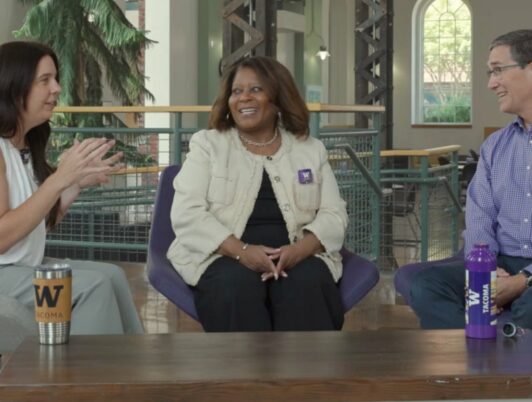
Marguerite Martin: I’m Marguerite with MoveToTacoma.com, and I’m here at the UWT [00:01:00] campus with Dr. Mentha Hynes-Wilson- That’s right … Vice Chancellor of Student Affairs. Mm-hmm. And Joe Lawless, the Chief Strategy Officer of the University of Washington of Tacoma.
Move to Tacoma Jingle: Yes.
Marguerite Martin: And we are here to talk about growth, and the campus’s growth- Mm-hmm … and how UWT is growing.
Mentha Hynes-Wilson: Yes.
Marguerite Martin: But first, I was hoping I could ask each of you when you moved to Tacoma and why. Can I start with you, Dr. Metha?
Mentha Hynes-Wilson: You sure can.
Marguerite Martin: Okay.
Mentha Hynes-Wilson: So thank you, Marguerite, and I moved to Tacoma back in 2017, and I was attracted to the University of Washington Tacoma because of its mission.
Marguerite Martin: Mm.
Mentha Hynes-Wilson: So where do I live now? We actually have planted roots in Lakewood.
Marguerite Martin: In Lakewood.
Mentha Hynes-Wilson: In Lakewood, yes, indeed.
Marguerite Martin: Okay, so the greater Tacoma area. Yes.
Mentha Hynes-Wilson: Yes, still Pierce County. You qualify. Yep, absolutely. Absolutely. So.
Marguerite Martin: What do you like about it there?
Mentha Hynes-Wilson: Um, I actually like the, uh, community, lots of green space, you know, all the different lakes that are surrounding us.
Um, but the other thing is the opportunity to kind of unplug. You know, I [00:02:00] spend a lot of time on campus, and I’m engaged with students, so jumping on I-5, even though it’s a little tumultuous, um, you know, those big rigs, woo-
Marguerite Martin: Yes …
Mentha Hynes-Wilson: um, but there’s that opportunity to just kind of put the music on- Mm-hmm … roll the windows down, and kinda chill on out as I’m motoring home.
Marguerite Martin: Do you have, like, a favorite place in Lakewood that you like to take people when they’re, like, coming to town?
Mentha Hynes-Wilson: Well, not in Lakewood, but in Steilacoom, which is not too far. Oh, yes, I love Steilacoom. There’s a little bar that I like. Which
Marguerite Martin: one?
Mentha Hynes-Wilson: Uh, it’s called… Oh, gosh. Uh, it’s now, I can’t think of the name. Um, Topside.
Marguerite Martin: Oh, the Topside with the rooftop deck- Yes … with the view of the ferry.
Mentha Hynes-Wilson: That’s it, Topside Grill.
Marguerite Martin: It’s so beautiful. That’s
Mentha Hynes-Wilson: our favorite little hangout.
Marguerite Martin: I love that place. Yeah. I know, like, they, that, that movie Practical Magic was filmed on Whidbey Island. Mm-hmm. But whenever I’m in Steilacoom, I feel like it’s very Practical Magic vibes.
Yeah, yeah.
Mentha Hynes-Wilson: And the cool thing about it, too, is you don’t run into too many people from Tacoma.
Marguerite Martin: That’s true.
Mentha Hynes-Wilson: Yeah. Well, that might change now.
Marguerite Martin: A little oasis over there.
Mentha Hynes-Wilson: That may change now since I’ve put it out on, you know, social-
Marguerite Martin: You’ve blown up the spot.
Mentha Hynes-Wilson: But love Topside. Um, we also like to go [00:03:00] for walks, um, at the park, um, right around the corner.
What’s the name of the park we were at, Joe, where we had the retreat?
Joe Lawless: Uh, Chambers Bay?
Mentha Hynes-Wilson: Nope.
Joe Lawless: Nope.
Mentha Hynes-Wilson: The gardens.
Joe Lawless: Oh, at Lakevold
Mentha Hynes-Wilson: Thank you. Lakevold Gardens.
Marguerite Martin: Lakevold Gardens in Lakewood.
Mentha Hynes-Wilson: Yep.
Marguerite Martin: And that’s right on the lake, right?
Mentha Hynes-Wilson: It is.
Marguerite Martin: Yeah.
Mentha Hynes-Wilson: It is.
Marguerite Martin: Beautiful.
Mentha Hynes-Wilson: It is. So that’s what we do.
Marguerite Martin: These are, these are good-
uh, suggestions for Lakewood. Thank you.
Mentha Hynes-Wilson: Yeah. Thank you.
Marguerite Martin: What about you, Joe? When did you move to Tacoma?
Joe Lawless: I moved to Tacoma, um, right up the hill at St. Joseph’s Hospital about 62 years ago. You
Marguerite Martin: were born into Tacoma.
Joe Lawless: I was born into Tacoma.
Marguerite Martin: Classic. A Tacoma original.
Joe Lawless: I’m an original, yeah. I grew up in the South End.
I’ve lived, uh, there for a long part, part of my life, and then, uh, off, lived off Sixth Avenue. And now I live over on the West Slope by the Narrows Bridge.
Marguerite Martin: Oh, wonderful. Do you have one of those sunset views?
Joe Lawless: I don’t.
Marguerite Martin: Oh. [00:04:00]
Joe Lawless: I don’t. Oh. I have a beautiful view of my garden.
Marguerite Martin: That’s a good, that’s a good one.
Mentha Hynes-Wilson: He has a beautiful garden.
Marguerite Martin: What do you love about living in the West Slope?
Joe Lawless: Uh, I love the centr- central nature, that you’re, you know, five minutes, 10 minutes from everything.
Marguerite Martin: Yeah.
Joe Lawless: Uh, just access to everything is, is really quick and easy. It takes me about 10 minutes to get down here to campus. So
Marguerite Martin: close.
Joe Lawless: Uh, yeah. Yeah.
Marguerite Martin: Do you have a favorite spot there that you like to take people?
Joe Lawless: Um, over there, probably not. We like to take, we like, love The Field Bar.
Marguerite Martin: Oh, yes.
Joe Lawless: On Sixth Ave. Yes.
Marguerite Martin: Yeah. Yes.
Joe Lawless: Uh, love to take our friends from out of town there.
Marguerite Martin: Well, and Sixth Ave too, I mean, it’s just like a straight shot- Yeah … from the West Loop. Yeah. That’s probably five, six minutes- It’s
Joe Lawless: five
Marguerite Martin: minutes, yeah
from you. Yeah. Oh, that’s great.
Joe Lawless: Yeah.
Marguerite Martin: Yeah, I went to The Field Bar recently, and like, I just always forget, like, the drinks are so good, and the service is so good.
Joe Lawless: Yes.
Marguerite Martin: Yeah.
Joe Lawless: Yeah, yeah. They’re the friendliest. They win the, win the prize for the [00:05:00] friendliest.
Marguerite Martin: They do. Have you been- Mm …
Mentha Hynes-Wilson: Amaka? I have not, but I’ve heard good things.
So I’ll go with- You’re going with me, so … so that we’ll be there. Yep. You know, when I moved to Tacoma, so there were so many different neighborhoods, we couldn’t decide where we wanted to live. It’s hard. You know, do you do the north side? Yeah. Do you do here? Do you do there? And I just- And
Marguerite Martin: everybody has an opinion.
Mentha Hynes-Wilson: And they do, right. Yeah. So my husband’s like, “That’s easy. We won’t do Tacoma. We’ll go outside of Tacoma.” So-
Marguerite Martin: Let’s solve that. … that’s how we were
Mentha Hynes-Wilson: able to resolve that, yep.
Marguerite Martin: But I could definitely understand too wanting a little distance from where you work, especially when you work in education. Yeah. But Joe, you’re, you’re right in it.
You’re just- I’m in it … you’re super close. Mm-hmm.
Joe Lawless: Yep.
Marguerite Martin: Campus- It’s interesting too that you grew up in the South End and you live on the, in the West, like you’ve never lived anywhere else?
Joe Lawless: Uh, I lived in Seattle for a short period of time, but I’m Tacoma through and through.
Marguerite Martin: Oh, I love that.
Joe Lawless: Mount Tahoma High School.
Marguerite Martin: Oh, wow. Yeah. What year did you gra- Am I allowed to ask what year you graduated?
Joe Lawless: Uh, well, I already said 62 years. You said you were 62, so. So 1983.
Marguerite Martin: Okay.
Joe Lawless: Yeah.
Marguerite Martin: So I, I’m really interested in talking today about kind of UW and its, like, role in the downtown area- Mm-hmm … and like how that [00:06:00] has changed over time.
‘Cause like I graduated in 1998, so like I, I was thinking about like when did I realize UWT was a thing? Mm. I think it was probably about the time I was graduating. Like, I knew it was here. Mm-hmm. And then there had been, I know it was like on the news, like would it come downtown or would it go somewhere else, and that decision-making process.
And then it was, it was, it was in a building downtown. We didn’t have all this yet, right? Yeah. How did it start, and then how did it evolve?
Joe Lawless: Mm-hmm. Yeah, it started with, uh, kind of a vision of Tacoma’s leaders.
Producer Doug Mackey: Mm-hmm.
Joe Lawless: Uh, said, “We need a, we need access to a public four-year institution in Tacoma.” Um, and went through the legislature, got the legislation passed that allowed for this.
Uh, opened in 1990 down in the Perkins building in- Mm-hmm … on 11th and A.
Marguerite Martin: Now condos.
Joe Lawless: Yes, now condos. Uh, but I think, I think they started on two floors, uh, and expanded there, but then moved to this campus. There was a lot of controversy over [00:07:00] where’s it gonna be sited? Hmm. And it was between this location on this 46 a- 46 acres downtown- Which
Marguerite Martin: was warehouses
Joe Lawless: which was warehouses- Like basically empty- Boarded up …
Marguerite Martin: correct.
Joe Lawless: Yeah. Correct. Empty warehouses. Uh, or over on the TCC campus- Mm … on the backside of the TCC campus, or out in a field in Fife.
Marguerite Martin: A field in Fife?
Joe Lawless: Yeah.
Marguerite Martin: Was
Joe Lawless: on the table. Um, on farmland. Yeah. Okay. Out in Fife.
Mentha Hynes-Wilson: Hadn’t heard that part.
Joe Lawless: And, uh, my recollection at least, uh, in the early ’90s is that, uh, Bill Phillip, uh, which we’re right across from Phillip Hall, uh, on campus, uh, Bill Phillip, who was the president of Puget Sound National Bank at the time, said it needs to be downtown.
Mentha Hynes-Wilson: Mm-hmm.
Joe Lawless: We need this campus- Mm … to be downtown. This needs to be part of our urban revitalization, adaptive reuse of these old, uh, grocery warehouses. Uh, and I, this is my opinion, I think he was right.
Marguerite Martin: Oh, yeah. In, in retrospect, that was pretty prescient.
Joe Lawless: Yeah.
Marguerite Martin: Yes. Right? Like-
Mentha Hynes-Wilson: [00:08:00] Absolutely …
Marguerite Martin: changed the course of how downtown has evolved.
Mentha Hynes-Wilson: Absolutely.
Joe Lawless: Yeah.
Mentha Hynes-Wilson: Absolutely.
Joe Lawless: Yeah. So, so yeah, we moved here, uh, started in, uh, uh, GWP. We… All of our buildings have, have, uh, interesting names ’cause they went back to their original name that they were when they were built.
Marguerite Martin: Right. Isn’t there one called Mattress Factory?
Joe Lawless: There’s the Mattress Factory.
Mentha Hynes-Wilson: That’s where my office is located, yes.
Joe Lawless: Yes. Uh, so GWP is the Gerritsen, Woodward, and Pratt building. Moved there. It’s where the bookstore is down on the bottom. Yeah. Uh, and, uh, in 1997, moved to this campus, and then started expanding out from there along Pacific Avenue, developing the, the old warehouses along that part of the rail line, and then slowly up, up the hill, um, and to the, to bring us to today, where we’re built on out on about- Half-ish of our campus footprint
Marguerite Martin: That blows my mind, because I remember seeing a map, like, back in 2001 [00:09:00] of the whole hillside, which was empty lots.
Mm-hmm. And people will always, “Oh, the downtown, it’s just full of empty lots.” And it’s like the university owns all that, and they’re- Mm-hmm … they’re moving, and you’re only halfway through- Yeah … all the lots you own. Like, you have so much expanding left to do. Yeah.
Joe Lawless: Correct.
Marguerite Martin: Yeah. And, and what, what is the vision?
Like, what is… How long does it take, and like, what, how much are you gonna fill in, and what… Is it housing? Is it- Right … classrooms?
Mentha Hynes-Wilson: All of the above.
Marguerite Martin: Okay. All of the above. All right. What’s coming?
Joe Lawless: Yep. Yeah. That’s actually… That was… We own a lot of it. So the state designated, it’s from Pacific Avenue all the way up to Tacoma Avenue.
Producer Doug Mackey: Okay.
Joe Lawless: And from 17th, uh, next to the convention center- Mm-hmm … down to 21st, which is where you get off the freeway. Yep. So that’s the square, that’s 46 acres, that was the designated campus. The s- We did not own all of the lots.
Move to Tacoma Jingle: Oh.
Joe Lawless: And what happened was, uh, in the late teens, private developers were buying up the lots and building apartment buildings on them.
Mm-hmm. [00:10:00] Market rate apartment buildings. Yes. And when our chancellor got here, uh, Dr. Sheila Edwards Lange, uh, she looked up the hill and said, “What, what is that? Why, why is that being built on our campus?” Yeah. Mm-hmm, mm-hmm. Uh, and so I explained to her that we didn’t own all the lots, and when they… It’s a free market.
Yeah. And people buy them, or we weren’t able to purchase them. So we went to the legislature at that time and asked for the capital funding to purchase the remaining lots in our footprint.
Producer Doug Mackey: Wow.
Joe Lawless: We’re almost done with that. There’s one more, uh, to, to happen, but now we own the other lots. We don’t own all of them.
The Buddhist temple is still there. Yeah. Um, the Harmon Building and, and, uh, School of the Arts, so that, um- Sure … so there’s a couple of buildings in that footprint that we don’t own, that we probably never will own. Mm-hmm. But all of the vacant land we’ve now owned. Which then when you start to do that, it rightfully so leads to the question, what are you gonna [00:11:00] do with all this land?
Marguerite Martin: Right.
Joe Lawless: So that, uh, led to us saying, “Hmm, our campus master plan hasn’t been redone since, I think it was 2008.”
Move to Tacoma Jingle: Okay.
Joe Lawless: Different world-
Move to Tacoma Jingle: Yeah …
Joe Lawless: since then. Uh, so let’s, let’s look at what the plan is for this. And so we did an RFP, got interest from all over the world. Um, we chose a firm called the Bjarke Ingels Group out of, uh, Copenhagen, Denmark.
We worked, uh, with their New York and Los Angeles offices. It’s a global… One of the largest global, uh, planning architecture firms in the world. Uh, and they really helped us to think big, engaged, basically anyone who would sit down long enough to give us their opinion.
Marguerite Martin: Right.
Joe Lawless: Uh, all of our students, faculty, staff- Mm-hmm
our community- Mm-hmm … uh, different community groups. Mm-hmm. [00:12:00] We held, uh, things here. We went out to different groups. We went and met with the tribe multiple times. Mm-hmm. Basically got all the feedback around what does the community wanna see?
Marguerite Martin: Like, about how you’re gonna grow.
Joe Lawless: About how we’re going to grow.
Uh-huh. And there’s some… That master plan has some really- Thoughtful. I’m, I’m biased. Right. But it has some very thoughtful elements in it of how, especially the edges. We have four unique edges, and how those edges connect to the community from a physical standpoint. Mm-hmm. And I’ll let Menta talk later about the core- Mm-hmm.
Yeah … and the center of campus. But the edges, um, you know, Pacific Avenue was developed- Right … to retail. Retail’s struggling right now, but we’re, you know, kinda working on plans to revitalize that Pacific Avenue corridor.
Mentha Hynes-Wilson: Mm-hmm.
Joe Lawless: 21st, uh, which ad- abuts the, the brewery district. Mm-hmm. And how do we connect to that, the convention center, and the [00:13:00] rest of downtown on the north?
Right. And then most importantly is Tacoma Avenue, which is kind of a- Mm-hmm … kind of the forgotten edge of campus right now. Mm-hmm.
Marguerite Martin: Although it’s kinda going through something.
Joe Lawless: It’s
Marguerite Martin: going through something. Like, there’s all these cute little businesses coming, popping up there right now.
Joe Lawless: Mm-hmm. Mm-hmm.
That’s exactly right. Yeah. That’s exactly right. Yeah. And, and the conversation we had with, uh, the planners was ab- what we cannot do is have Tacoma Avenue be our back door-
Move to Tacoma Jingle: Right …
Joe Lawless: and Pacific Avenue be our front door.
Move to Tacoma Jingle: Mm-hmm.
Joe Lawless: That has to be a second front door. Because of Tacoma’s history with the Hilltop-
Marguerite Martin: Yeah
Joe Lawless: and the Hilltop neighborhoods, that needs to be a welcoming, uh, front door to campus. So yes- Like, it’s not
Marguerite Martin: an afterthought. It’s not. This is an equal priority
Joe Lawless: to- Yeah … Pacific
Marguerite Martin: Avenue.
Joe Lawless: Exactly. Okay. Correct. Um, but it’s not a back door. There’s houses, some houses have two front doors.
Marguerite Martin: Yeah.
Joe Lawless: And ours will.
Mentha Hynes-Wilson: Mm-hmm.
Marguerite Martin: That’s great.
Joe Lawless: So.
Mentha Hynes-Wilson: You know, if I could, I wanna go back to that story about the found, what I refer to as the founding mothers and fathers of this campus. Mm-hmm. So for me, they r- absolutely were visionary in saying that the UDub needs to have an anchor [00:14:00] in Tacoma.
Marguerite Martin: Mm-hmm.
Mentha Hynes-Wilson: That Tacoma is a place for individuals who have high promise of potential too-
Marguerite Martin: Yes
Mentha Hynes-Wilson: but may or may not be able to make it to Seattle- Yes … or have these other kinds of obligations. And so I agree with them spot on. Tacoma has rooted itself in downtown. It has transformed the community, um, and there is something about the funkiness of its architecture. Yeah. There’s something about the funkiness of the students that we attract.
Um, and I think in terms of about the campus plan and where we’re growing, it really is one of those in which we see ourselves not only contributing to the vitality of the university community, the vitality of the South Sound, but also we’re attracting students who are gonna go on and do amazing things, as our alums have already demonstrated that they’re doing.
Yes,
Marguerite Martin: yes.
Mentha Hynes-Wilson: Um, and at the heart of that really is gonna be the dining facility, the new residence hall, and other kinds of explorations that we’re exploring down the road
Marguerite Martin: Well, I’m, I’m very curious. I was, um, accidentally invited to a 21 run recently. Okay. I haven’t been to one in a really long time, but this poor girl, she turns 21- How’d you do, though?
I, I didn’t do [00:15:00] great. Honestly, I didn’t do great. Um, it was, sh- she was the first one in her group to turn 21. Mm-hmm. So she went out with her mom and her mom’s friends. Mm. And I was one of those friends. Okay. But she had, she had, like, a few, there were some youngs. Uh, and we, by the way, the kids are still going out on Pacific Avenue.
I didn’t know about this ’cause I’m in bed with TikTok at 9:00. But, like, when you go out at night on Pacific Avenue, like, it’s popping. Mm-hmm. And, like, there’s all these places that people are, people are in this, in the bars, people are at McMenamins. It was really cool. But a couple of the students were saying that they were U of T students.
Mm. And I was like, “Oh, like, what is it like?” And they’re like, “Oh, well, we, we commute. We still live at home, and we commute into campus.” Mm-hmm. But I know that this is about to change. We’re starting to get more housing on campus. That’s correct. There’s a, the, we’re at this kind of crossroads. So what is, what have you been as far as campus life, and what are you about to become?
Mentha Hynes-Wilson: Yes. Yes, yes. So when I arrived in 2017, um, I took the time to really talk to students and get a sense of what’s the pulse here.
Marguerite Martin: Mm-hmm.
Mentha Hynes-Wilson: Um, and what students shared is that we’re a commuter campus. We come to campus, we take our classes, we jump back in our car or back on the train or what have you- Mm-hmm
and we head [00:16:00] on out So we began to imagine w- how that could shift. We already owned Court 17, so a small footprint. Mm-hmm. 200, 300 students were residing there.
Move to Tacoma Jingle: Mm-hmm.
Mentha Hynes-Wilson: But could we go larger than that? Would there be demand? Would there be the ability to really grow?
Move to Tacoma Jingle: Right.
Mentha Hynes-Wilson: And so what we heard from students is, “Yes, we’re absolutely interested.
You make available more options, we will be all about it. We want to be able to have greater access to our faculty members, to have a 24/7 kinda dynamic, and not just breeze in and breeze out.” So over the last several years, we’ve been slowly and intentionally moving in that direction. So you’ll find that there’s much more activity happening on campus after 12:00 noon.
You know, there are many more, um, dining facilities in the area. Yeah. We’ve also adopted a food truck program, which is really popular. So on Tuesdays, we got local vendors who are coming to campus. Students yesterday told me that was the best thing ever.
Marguerite Martin: Um- Where do they go? Where do the trucks go?
Mentha Hynes-Wilson: The trucks go right over here by the Mattress Factory.
Oh,
Marguerite Martin: okay. On the little V-shaped
Mentha Hynes-Wilson: lot here. That’s exactly right. Okay. Got it,
Marguerite Martin: got
Mentha Hynes-Wilson: it. [00:17:00] Yep, yep. Very close. Yep, so it’s hap- happening, um, spot on Tuesdays. They arrive at 11:30. Some food trucks will stay there until 5:00 o’clock, depending upon the activity.
Move to Tacoma Jingle: Very cool.
Mentha Hynes-Wilson: So in terms of housing and dining, Court 17 has become an attraction as well.
So I was talking to the director just yesterday, and we have a wait list of 100 folks who are trying to get into that space. So we know demand is pretty high for housing and dining. We know demand is, um, increasing in terms of our activities on campus. We laugh about it becoming a sticky campus. Yep. So in other words, students are sticking around- Yeah
in between classes, and it’s just really quite fun to see all this happening. It’s fun in that the Student Affairs team is involved in those conversations, Academic Affairs, the entire campus, but most importantly, we’re really listening to our students. Mm-hmm. We’re keying into what it is that they say they want and they need, and how we can support them in their growth and their development.
Marguerite Martin: Is there a number of, like, students living on campus that’s, like, a threshold that you’re kinda aiming for that you’re like, “And then we’ll have a vibrant [00:18:00] 24-hour situation”?
Mentha Hynes-Wilson: Right. It depends upon who you talk to.
Marguerite Martin: Okay.
Mentha Hynes-Wilson: Um- …
Marguerite Martin: what’s the range?
Joe Lawless: Um, I, our, our master plan, uh, plans for us to have 15% of our student population living on campus as we grow. How, how many
Marguerite Martin: people is that? I don’t know how many-
Mentha Hynes-Wilson: Yeah. So right now they’re 5,000.
Joe Lawless: Right now there’s 5,000. Mm-hmm. And we have 300. Mm-hmm. We’re building 450 beds- Mm-hmm … of more traditional dorm style housing.
Marguerite Martin: Mm-hmm.
Joe Lawless: Right now what we have is an apartment building- Yep … that’s being used, you know, that sits in a food desert, by the way-
Marguerite Martin: Yeah. Yeah …
Joe Lawless: uh, in terms of access to groceries, and so- I
Marguerite Martin: also live downtown, so I feel the- Yeah. Yeah, there’s no grocery store. Oh, yeah,
Joe Lawless: no. Yeah. Yeah, yeah. So makes it ch- more challenging for an 18-year-old student to come and live in an apartment building.
Um, so building more traditional, uh, dorm style housing with the dining hall, that’s the key- Mm-hmm … part. That’s the, kind of the, the magic sauce, uh, to make it all [00:19:00] work.
Marguerite Martin: Yeah. How many UWT students do we need to convince someone that we can get a grocery store downtown? Yeah. That’s the vision. Like-
Joe Lawless: That,
Marguerite Martin: right
even just a mini-mart, like, uh- Yeah … open till 8:00 or 9:00. Yeah. That would be great.
Joe Lawless: Yeah. Sure. Yeah, yeah. Yeah. Totally. Totally. A
Marguerite Martin: couple of apples and a banana. Yep. That’s all I need.
Joe Lawless: Yep. So, so the, the goal is to, to grow and keep it at 15. We’ll, we’ll have about, after, after we build these, they’ll open in the autumn of 2029.
So I’ve, I’ve been… I fig- figured out the math and said, “If you have a high school sophomore right now-”
Producer Doug Mackey: Okay. “…
Joe Lawless: who’s looking for an, a residential campus experience- They can have it here … you’re gonna have it in Tacoma- Mm-hmm. Okay … in autumn of 2029.
Producer Doug Mackey: Mm-hmm.
Joe Lawless: Uh, and, um, so we’ll end up with about 650, 700, um, residential.
And the, our plan is, and what we were partially testing with that master plan, was do… ‘Cause we have said this campus is designed to hold 10,000 students.
Producer Doug Mackey: Mm-hmm.
Joe Lawless: So we were testing that a little bit. [00:20:00] Given building lots and height restrictions and how much will 10,000 figure, it fits very easily.
Producer Doug Mackey: Mm-hmm.
Joe Lawless: Um, so the, the goal is to… And we don’t have a date, we just have that we want to continue growing to meet the needs of the community, uh, that we will grow to 10,000, and that ultimately we’ll have about 1,500 students living on campus. Mm-hmm. And then those, you know, will always be 85% commuter.
Mentha Hynes-Wilson: Mm-hmm.
Mm-hmm.
Joe Lawless: But having 1,500 students living on campus creates a different campus experience- Absolutely 100% … that benefits the commuters too. Yep.
Move to Tacoma Jingle: Yes.
Mentha Hynes-Wilson: Yep. Yes. So it’s a both and dynamic. Yeah. So we’re not losing our identity as a commuter campus, nor are we attempting to be 100% residential. Mm-hmm. So what’s that sweet spot?
Yeah. And we think that 1,500 is the way to go. And there’ll be a continuum too, so there’s that con- uh, traditional residence experience in the dining hall. Then when you become a bit more independent and you don’t want so much activity-
Marguerite Martin: Right, you might live nearby.
Mentha Hynes-Wilson: Exactly. Yeah. You live next door into [00:21:00] Court 17, the apartments.
Yeah. And then when that’s too much for you, you can go right across the way into one of the apartments that are privately owned, so.
Marguerite Martin: That makes a lot of sense.
Mentha Hynes-Wilson: Mm-hmm.
Marguerite Martin: So what, how are you kind of thinking about student life and the student experience- Mm-hmm … uh, right now and as you’re growing? Mm-hmm. Like, what’s the vision?
Mentha Hynes-Wilson: Mm-hmm. The vision is to be able to address our students’ basic needs initially. So we know that a high proportion of our students are, um, facing food insecurity and housing insecurity.
Marguerite Martin: Mm.
Mentha Hynes-Wilson: So we have a fabulous network of services and programs that we make available in the Mattress Factory. Um, we have a social worker who’s there, who will help students with personal coaching.
We have emergency aid programs that are in place. We have a pantry program. We have, um, partnerships with, um, Nourish Mobile Food Truck.
Marguerite Martin: Mm-hmm.
Mentha Hynes-Wilson: Food Pantry, I should say. Um, and we have another, um, partnership that’s coming online with Good Roots, um, which will offer 24/7 refrig- refrigerated fresh food products that are available to students and community members.
And I wanna underscore community members, too- Yeah … [00:22:00] because much of what we do also is for the local neighborhood. I’m
Marguerite Martin: hearing that. Yeah. And I, I live, like, 10-minute walk over there. Oh,
Mentha Hynes-Wilson: okay.
Marguerite Martin: So if, whatever you have- Good … that I can come get- Yeah … I wanna know about it.
Mentha Hynes-Wilson: And your comment about, you know, being a food desert and no grocery store- Yeah
that’s definitely on my mind, too. Yes. So we’ve been reaching out to folks, trying to figure out how we can make that happen. You know, if it’s a bodega, you know- Yeah … something to start.
Marguerite Martin: That alone- Right … that alone would be- Yeah … a game changer.
Mentha Hynes-Wilson: Yeah.
Marguerite Martin: Okay, so I wanna revisit something you just said, which is that, you know, a lot of the students are needing, like, services- Mm-hmm
and things like food, and it’s like, well, I mean, the entire population, that’s not just a college student thing.
Mentha Hynes-Wilson: That’s correct.
Marguerite Martin: That’s the whole population, and how many of those students were experiencing that in their homes- Mm-hmm … before they went to school- Yeah … and how many might be just, like, they’re out on their own now, and they’ve got to kind of pa- which I think a lot of people can remember from being in their early 20s and out on their own.
That’s right. Like- That’s right … it’s just hard to make it work.
Mentha Hynes-Wilson: That’s
Marguerite Martin: right. So, like- That’s right … what, what, how, what is the balance of that? Like-
Mentha Hynes-Wilson: So it’s become more complicated. So we can talk about, I think back to when I was an undergraduate, and we would joke about eating Top Ramen in ketchup, right?
That was the kind of [00:23:00] thing that sustained us, right? But it’s so more intense, so more pervasive. Um, and so we have found nationally, colleges and universities are, um, engaged in this work, and our students, about 30% of our students are reporting and meet the definition of being food insecure.
Marguerite Martin: Mm.
Mentha Hynes-Wilson: So there’s a lot of work that needs to be done there.
We’ve, um, created many roads for students to find resources. We have something called The Cupboard. It’s called Hungry Now, Eat Now. Mm-hmm. So swing by our office, pick up a granola bar, piece of fruit, some milk.
Move to Tacoma Jingle: Mm-hmm.
Mentha Hynes-Wilson: Head on off to class. No questions asked, no judgment, nothing of that nature.
Move to Tacoma Jingle: Mm-hmm.
Mentha Hynes-Wilson: We’ve also really tried to adopt this premise of it’s okay to ask for help.
You’re a part of a community. So community, we look out for each other. Us, we care about each other.
Move to Tacoma Jingle: Mm-hmm.
Mentha Hynes-Wilson: So if you need some assistance, feel free to come by the Mattress Factory, talk to Joe. Joe will refer you to someone. But it really is this nat- no- this notion of you’re not alone in this space. [00:24:00] We know that life outside of UW Tacoma can be, again, complicated, but when you come here, you’re a part of an extended community.
We care about you, we see about you, we want you to know that you’re valued. Mm. Um, and I’m happy to report that students are picking up on that. Yeah. We had a meeting yesterday of our team interfacing with students, a number of student ambassadors, probably seven or so, and we asked them what’s the most memorable thing about their Tacoma experience right now, and consistently they were saying, “We know that you all care about us.”
Marguerite Martin: Mm. ”
Mentha Hynes-Wilson: We get the sense that you see us,” right? “We don’t have to struggle when we come to this campus. If we have a struggle, we know you’re gonna help us try and figure it out. We also know you’re gonna hold us accountable.” Right. “That at the end of the day, we’re here to get a degree, and so that’s gonna be our primary focus.”
But in addition to that, there’s a whole complement of things outside of the classroom to make you a better person, to make you a stronger person, to feel, um, like you can almost do anything. Mm. And that’s really my goal. I want every student on campus to feel like they’re special, and they can do anything- Yeah
with the right amount of support.
Marguerite Martin: [00:25:00] That’s awesome. Yeah.
Joe Lawless: Going back to, to something you said, our, our students are from this community.
Marguerite Martin: Yes.
Joe Lawless: They’re-
Marguerite Martin: They’re not coming from Ohio-
Joe Lawless: They’re not coming from- … mostly. Yeah, other states, other countries- … other… They’re from this community. 92% of our students come from the South Sound.
Marguerite Martin: Okay.
Joe Lawless: Uh, and I think then the number is 80% of them stay here.
Marguerite Martin: Correct. Yeah.
Joe Lawless: So they’re coming from this community, they’re staying in this community, and they look like this community.
Producer Doug Mackey: Mm-hmm.
Joe Lawless: Mm-hmm. Um, more than half of our students are the first in their families to go to college, uh, which is a high percentage for universities nationally.
Producer Doug Mackey: Mm-hmm.
Joe Lawless: Um, more than half of our students are Pell eligible.
Producer Doug Mackey: Mm-hmm.
Joe Lawless: Uh, and 60% of our students are students of color. We look like Tacoma. We are Tacoma. We
Mentha Hynes-Wilson: are Tacoma.
Joe Lawless: Mm. Mm-hmm. Um, so, uh, so it makes sense that our students would be food insecure- Mm … because it’s going around.
Marguerite Martin: Yeah, absolutely.
Joe Lawless: So.
Mentha Hynes-Wilson: And I would argue not only are we Tacoma, but I think we are also the face of higher ed and the [00:26:00] world going forward, right?
Yeah. So. Mm-hmm.
Marguerite Martin: Well, this is a good spot to
Producer Doug Mackey: go to break. We’ll be right back
Marguerite Martin: I wanna thank UW Tacoma for their sponsorship of Channel 253. As a longtime downtown Tacoma resident, University of Washington Tacoma is one of my neighbors, and they’re adding more downtown Tacoma residents each year to this growing campus.
This past year, UWT celebrated 35 years and 35,000 graduates, which is a pretty big milestone for this university, this community, and these students. Many thanks to the Tacoma Huskies for your support of Channel 253 and for being an important part of downtown Tacoma life. We’re back with Mentha and Joe from the University of Washington Tacoma talking about campus life- Mm-hmm
how the campus is growing- Mm-hmm … how the campus fits into downtown. And before the break, you were talking about this idea of there being, like, a [00:27:00] heart of the UWT campus. What do you mean by that? And what is, what is, what is supposed to be happening?
Mentha Hynes-Wilson: Yeah.
Marguerite Martin: Does it have a heart yet? Is, are you building the heart?
Mentha Hynes-Wilson: We, we have a heart. Um, we’re expanding upon the heart and expanding the heartbeat, and I think this is something where- Yeah … we really just kinda vibe on that a lot. Um, you know, part of Student Affairs, our work is all-encompassing, so we’re looking at students from the moment they arrive, from the admissions process, from in between.
We’re talking about their care and their wellbeing. And then on the other end, career exploration, career preparation.
Marguerite Martin: Right.
Mentha Hynes-Wilson: So if you feel it, for me, I think about students and faculty, they’re more concerned, cerebral, about the brain, right?
Marguerite Martin: Right.
Mentha Hynes-Wilson: We’re the heart. We’re the warm and fuzzy. And so a lot of our work is focused in that regard, and also making students understand that they too are at the center of all that we do.
And that physically is gonna have a manifestation in terms of where the residence halls are situated, and then also the expansion of our student supports program. So I’m gonna hand that off to Joe, who’s looking at it more from the kinda- Yeah … interior, exterior building aspect of it, [00:28:00] and then I can talk about the warm and fuzzy plugin.
Marguerite Martin: When I mention, like, this is important because we want students to make it all the way through.
Mentha Hynes-Wilson: Correct.
Marguerite Martin: Yeah. Right? And, and that feeling of belonging and connection to the c- and, like, everything working well for them and them feeling supported, that means they complete their degree, right? That’s an important point.
‘Cause that’s the, it’s not just, like, warm and fuzzy- Yeah, yeah … hippy dippy.
Mentha Hynes-Wilson: Yeah.
Marguerite Martin: We’re your new family. Yeah. Like, it’s you- Yeah … right?
Mentha Hynes-Wilson: Yeah, and I’m glad you, let’s pull on that thread. Yeah. So sense of belonging’s absolutely important. So the really wonderful thing about U Dub Tacoma is that, as I mentioned, you know, we, the students that we attract, we have a really good track record of graduating students.
So they come here because of the programs that we offer, they benefit from the wraparound support that we provide, and then they go on to graduate. Like, one of the most warm and fuzzy moments is being at the Tacoma Dome last June-
Marguerite Martin: Right …
Mentha Hynes-Wilson: and seeing 1,600 students go across the stage- Yeah … with a U Dub degree.
Yeah. Right? So at the end of the day, it really is about getting them over the finish line, and also enhancing their opportunities for career and social mobility. Um, so it’s all [00:29:00] interconnected. So the ways in which we do this work is intentional, it’s thoughtful, it’s putting centers, um, a lot of energy around the student need, but also how faculty, staff, alumni, and community members also contribute to that mosaic of the student experience.
Joe Lawless: Yep. And in the planning process, there’s kind of two philosophies you can take in terms of planning a, a campus. One is put the students at the edges, put your housing and student services around the edges- Mm-hmm … and put academics in the middle.
Marguerite Martin: Mm-hmm.
Joe Lawless: Or put students in the middle and put academics around the edges where they connect out to the community.
Marguerite Martin: And is this something that, like, across the country, like, different universities have tried both styles for like- Mm-hmm … 100 years? Yeah. Or is this a recent emerging debate?
Joe Lawless: You, you will fi… You know, go back to the East Coast- Mm-hmm. Mm-hmm … and walk around and you’ll walk up against these walls, uh, where on the other side of that wall is a university.
Mm-hmm. Mm-hmm. Um, and we, we wanted to be really, really intentional about [00:30:00] there are no walls at UWT. Mm-hmm. We don’t… I mean, that would be so antithetical to our philosophy of engagement with the community and being part of the community. And we really, the, uh, the leadership on the Tacoma campus really advocated for the philosophy of putting students at the heart.
Move to Tacoma Jingle: Mm-hmm.
Joe Lawless: Mentha’s talked about, about students being kind of the heart of our campus. Physically, the infrastructure has to represent that too. Yes. So we’re putting our student housing there. The Y, the Y actually is up ag- up against the edge, but that’s kind of part of the heart.
Marguerite Martin: Well, and just as a side note-
as someone who lives downtown, it’s a really good Y. It is. And, like, nor- a- and normal people can go- Yep … not just students, right? It, it- If you’re a member of the Y- Yep. Yep … of any of the Ys- Absolutely … you can come to this Y, and it’s a good one.
Joe Lawless: Mm-hmm. And the big secret is student… Well, this isn’t a big secret.
Students. It’s not a secret anymore. Students don’t like the mornings.
Marguerite Martin: Um- No, it’s like the only Y in town that’s like- … you can get in there in the morning.
Joe Lawless: In the mornings- It’s true … it’s a great [00:31:00] place to go. Yeah.
Marguerite Martin: Yeah.
Joe Lawless: So we really wanted to make sure that students were in the middle, putting housing there, putting, you know, the Y is connected to that.
And then on the other side of this campus core commons area that we’re gonna build in the middle, kind of where 19th Street comes down the hill next to the Swiss- Mm-hmm … from there over to the edge of the housing, that center of campus- Mm … will be this open space, uh, that is right up next to the Swiss, which we are going to the legislature next year for capital funding to renovate our last three historic buildings on our campus, which is the Swiss, Wild, uh, and Tioga buildings.
And renovate those with the idea of moving Student Affairs, which is in the Mattress Factory on the edge of campus now-
Producer Doug Mackey: Mm-hmm …
Joe Lawless: into the center, to have all of the services that sh- that, uh, Mentha was talking about in the middle right adjacent to dining hall and housing and, uh, this commons area in the middle, uh, that really- [00:32:00] From a physical infrastructure standpoint, put students in the center.
Marguerite Martin: That’s great.
Joe Lawless: Um-
Mentha Hynes-Wilson: And since you live downtown, I’m gonna invite you to come to the MATES Factory at some point. Yeah. And you’re gonna s- see all the activity that happens there. So on the lower level, it’s kind of like a student, um, center. So pool table, the gamers are there. I had
Marguerite Martin: no idea.
Mentha Hynes-Wilson: The hot dog, Rod’s Hot Dogs is there.
Um, so there’s lots of activity that happens. But students complain sometimes because on the one hand there’s a group that’s studying, but then there’s a group that also is watching TV. Right. So we gotta tease all that out.
Marguerite Martin: Right. That’s, I think that’s probably every college campus in America.
Mentha Hynes-Wilson: Right, right.
But then you also have the complement of student support programs too. So everything from spaces for our first gen students. We have spaces for students who are formerly incarcerated. Mm-hmm. I mean, it’s just a really popping kind of place. We think of it as a student hub. So we’re imagining that moving into a different location that, again, is more anchored in the heart of the campus, and actually gives us more, um, um, space to do our work.
Marguerite Martin: Okay. I’m gonna ask [00:33:00] a question, but first I’m gonna reference another university in town. I was on a walk with a girlfriend in the spring, and we were walking- There’s another university? There is a universe, uh, it’s, uh, the, it’s the Loggers. Oh. What they call it now. Oh, okay. Yeah. UPS. You know, what they call it Puget Sound now.
Oh. Yes. But we were walking around Puget Sound, and we bumped into a friend of hers, and she’s like, “Oh yeah, me and my son, we were just getting pizza at the university.” Mm-hmm. And we were like, “The what?” And we went and got, like, $3 slices in the, you know, cafeteria basement of Puget Sound. Yep. And I was like, man, I…
And it, it sparked something in me. I was like, you know, they have events here. Mm-hmm. They have speakers come to town. Mm-hmm. This is a college campus. I should probably be plugging in and paying attention to what speakers they’re getting. Mm-hmm. Uh, and I live two blocks from UWT. Mm-hmm. And I’m like, “Do you have $3 pizza that I can come and eat?
Do you have- It’s $5 … uh, speakers?” And it… $5. Okay. You know what? We gotta pay a living wage. We gotta pay a living wage. That’s fair. But, like-
Mentha Hynes-Wilson: And you get a soda with that …
Marguerite Martin: I, well, okay. Okay. That’s a whole nother thing. Okay. Yes. That, yes. I’m in. No, but this is the whole thing, right, is like, I’m a local resident, but I don’t necessarily think- Can I [00:34:00] come to campus?
Even coming to the library today, you know, we’re filming in the library, like, I was like, “Oh, I wonder if I’ll have to call somebody to get into the library.” Mm. I’ll have to use a key card to get- Mm. But the doors just opened. Mm-hmm. And I think that that’s something that I didn’t know, even living a couple blocks away.
Yeah. So what is the… But what is the invitation to the community? Which parts are we supposed to access, and which parts are we supposed to- Yeah … not access?
Mentha Hynes-Wilson: I like that question.
Marguerite Martin: Yeah.
Joe Lawless: Yeah. It is a good question.
Marguerite Martin: Can we go together on a bodega? Yeah. Like, how do we make this happen?
Mentha Hynes-Wilson: I think we would gather more success if we do that, actually.
Marguerite Martin: Yeah. Like, we need a, like, a movement. Let’s work together.
Mentha Hynes-Wilson: Um, I personally would say there’s an open invitation for community members to come to campus. So as Joe has indicated, we really don’t have those barriers. Mm-hmm. And if there are, they’re artificial barriers. So everyone is welcome onto the campus as long as they are contributing to the cons- um, constructive vitality of what we’re doing.
Good
Marguerite Martin: vibes only.
Mentha Hynes-Wilson: Right? Yes. Good vibes only. Good vibes only. There are lectures that happen. Yeah. There are performances that happen. Um, and we really are trying to do [00:35:00] more and more of that.
Marguerite Martin: We- What’s the best way to find out about that kind of stuff? Well- That’s why I’m like, I, I feel
Mentha Hynes-Wilson: like- Well, I will
Marguerite Martin: acknowledge-
you guys have great speakers and teachers …
Mentha Hynes-Wilson: I will acknowledge we probably need to work a little more on that.
Marguerite Martin: Okay.
Mentha Hynes-Wilson: Um, but I would say our website is probably- Okay … the best location to find that. And then also as you’re walking through campus, you’ll see all sorts of A-frames and wonderful flyers and posters and things- Mm-hmm
that are advertising different events.
Marguerite Martin: Okay.
Mentha Hynes-Wilson: Yeah.
Joe Lawless: About, it’s probably a year and a half ago, uh, Council Member Rumba held her town hall here on campus, and I was, uh, a little bit surprised by the number of downtown residents who came to it, who live here. So I was curio- I, you know, I’m a curious person, so I went and asked them, “So Why?
Why are you here? Um, and what’s your connection to our campus? And across the board they all said, “You’re, you’re our public space. You’re our park. You’re where- Mm. Mm-hmm … we come- Mm-hmm … to walk our dogs, to be in nature- Be in nature … to go walk along the Prairie Line Trail.” And, uh, so I, I was a little [00:36:00] bit surprised by that.
Uh, and that’s actually what led to us talking about our expansion plans as downtown Tacoma’s largest park.
Marguerite Martin: Yeah.
Joe Lawless: Uh, so because we’re planning on planting a lot of trees. That’s good. This is also, right now, a heat island. Um- Yeah. The tree canopy in Tacoma- Yeah … is one of the lowest-
Marguerite Martin: Yeah …
Joe Lawless: ma’am. Um, have you had the Tree Foundation on yet?
Marguerite Martin: No, but I’ve, I- Yet? … I follow them on Instagram. Like Tacoma Tree Foundation is doing the work- Yes … to get the trees out there.
Joe Lawless: Yes. Uh, Lowell, I’m sure Lowell would be happy to come talk with you. Yeah. No, I’d
Marguerite Martin: love to talk with them.
Joe Lawless: Uh, but planting trees, getting, getting trees on this campus, having it be this, um, oasis in downtown Tacoma, the, the community is welcome to that.
Mentha Hynes-Wilson: Mm-hmm.
Joe Lawless: Uh, invited to and welcome to. Mm-hmm. That we want the community to engage with our campus- Mm-hmm. Mm-hmm … uh, as part of who we are.
Mentha Hynes-Wilson: Mm-hmm. Community engagement. So faculty members are very involved in creating programs, activities, classes, in which students are required to go out and be involved in some capacity.
Mm. We have a Husky [00:37:00] volunteer program too, in which our students are actively looking for ways in which they can connect- Mm. Mm … with the residents of Tacoma. Um, and then when you think about these informal gathering spaces, from the different coffee houses we have on campus- Right … multiple pizza places.
Right. Um, students are always distributing flyers and things. But I would say, yes, we are open. We want to see more activity, and we will be working on that in the coming months and weeks.
Marguerite Martin: So if somebody is listening or watching and they’re, like, an employer or they- Mm. They, they’re, they’re like, “Oh, I think there might be a way for us to plug in with the campus.
We hadn’t thought about that before.” Like, what are the, what’s the invitation? Like, what are some pos- potential scenarios that a community member could plug in with the campus- Oh, my gosh … in different ways?
Mentha Hynes-Wilson: So first- Like,
Marguerite Martin: I went right to employer, but-
Mentha Hynes-Wilson: Yeah. Yeah … I
Marguerite Martin: know there’s probably
Mentha Hynes-Wilson: others. So no, employer.
Yeah. First thing that came to mind for me is, um, so since career development sits in our area, um, we are always looking for ways in which students can have internship opportunities. So we have a program that we refer to as micro-internship opportunities. Mm. And so you can definitely contact, uh, Joe, contact me, to learn what that looks like.
We’ve had individual students who’ve [00:38:00] worked, say, in KeyBank. We’ve had folks who’ve done internships on campus in marketing and communication. We’ve had folks who’ve been affiliated in the healthcare wa- industry. Mm-hmm. So they’re just, you know, what are your needs? Our students are available to support those needs.
Marguerite Martin: Okay.
Joe Lawless: Yeah.
Mentha Hynes-Wilson: Yeah.
Joe Lawless: Career connectedness is, is really important for our students right now, increasingly as we move forward. Connection from your degree to your career is going to increasingly be important.
Mentha Hynes-Wilson: Mm-hmm.
Joe Lawless: Um, and I think it’s one of the things that… It’s one of the strengths of UW Tacoma-
Mentha Hynes-Wilson: Yes …
Joe Lawless: is our, you know, we call ourselves an urban serving university, community engaged campus.
Uh, we have an office of community partnerships that is intentional about creating the linkage between the faculty member in the classroom and the project in the community. Um, so I- we have leaned into that already. Uh, we have the Carnegie Community Engaged Classification, which is an optional [00:39:00] classification you can get, uh, which isn’t easy, by the way.
Mm. Uh, and, we’re, I think we’re well-positioned to lean even more into that in terms of creating opportunities for our students to engage in the community, whether it’s with, you know, the nonprofit sector, businesses- Mm … or volunteer opportunities or career opportunities. All of those are ways that businesses, companies, organizations in the community can connect with our campus, uh, and our students, um, to create that kinda ecosystem that will benefit- Yes, our students and their families, but also our community.
Mentha Hynes-Wilson: Mm-hmm. Let me drop a commercial out there too. Mm. So Fun Vibes, bring your good vibes to campus during Husky Fest. Mm. So every spring we now hold something called a b- it’s a block party- Mm … and we call it Husky Fest. I
Producer Doug Mackey: did not know this. Oh,
Marguerite Martin: wow. I know. I feel very out of the loop all of a sudden.
Mentha Hynes-Wilson: Personal invitations.
Please. Come, just come.
Marguerite Martin: Okay. All
Mentha Hynes-Wilson: right. So Husky Fest- I can come … um, so you know, of course, [00:40:00] we got the food trucks, but we also have performances that are happening. We’ve got the marching band, drum line, um, we- And you
Marguerite Martin: want people to come
Mentha Hynes-Wilson: that are not going here. We want people to come. Yeah. Yes. Yeah. And that was designed purposely for that very reason.
Mm. Community members would say, “Well, we do come for this, and we know that this happens, but do you really want us there?”
Marguerite Martin: Yeah.
Mentha Hynes-Wilson: And that was our way to try to signal, “Yes, we do want you here.”
Marguerite Martin: Well, and I hear myself asking that right now- Mm-hmm … in, like, 12 different ways. But I think that that is the, that is the thing, is it’s like there is so much going on here, and, uh, and what I’m hearing from you- you two over and over is, like, whether it’s an employer, whether it’s somebody that lives around the corner, like, there is a way for you to become a part of this.
Mentha Hynes-Wilson: Yes.
Marguerite Martin: And my head is going to also, like, once you graduate college- Mm-hmm … and you go into your career- Mm-hmm … like, it’s not over. Like, I’m turning 47 next month. Yeah. Like, you’re gonna have a midlife crisis- Yeah … and you’re wa- you’re gonna wanna do something else. Yeah. Or you’re gonna get fired. Or your kids- Yeah
are gonna go to college- Yeah … and you’re gonna wanna do something else. Yeah. And I feel like there’s a reverse process of plugging in- Mm-hmm … where it’s like you’re not quite ready to go [00:41:00] back to school yet, but you’re- you’re interested. And what is, you know, is that invitation there for people who are, like, you know, wanting to plug in academically in a lighter way than just, like, I’m ready for a- Mm
a BA or a master’s
Mentha Hynes-Wilson: or
Marguerite Martin: something?
Mentha Hynes-Wilson: Yeah. Yeah. Right. So I think about it in terms of lifelong connections. Mm. So once you become a Husky, you’re always a Husky. Mm-hmm. Right? And then there are ways in which student or, uh, community members can take a course on campus- Oh … without being a fully matriculated student.
So you wanna talk about that program?
Joe Lawless: Non-matric. Yeah. Um, so you can be a non-matriculated student, take a course, and try things out. I call it the taste test.
Marguerite Martin: How do you do that? I’ve never heard of this. How do you do that?
Joe Lawless: You walk over to method shop.
Mentha Hynes-Wilson: Come to the second floor of the Mattress Factory.
Second floor of the Mattress Factory. Told you, the Mattress Factory, a lot of- That’s where it’s all happening … a lot of magic happens in the Mattress Factory. Yeah.
Joe Lawless: Uh-huh. And if you’re over, I forget the age, I wanna say if you’re over 55, Wa- State of Washington actually has a pro- an access program where you can take any college course at any state university-
Marguerite Martin: Wait, wait,
Joe Lawless: wait
for 15- Say that again … for [00:42:00] $15.
Marguerite Martin: You, you can… Okay, so if you- Used to be … in Washington State, if you’re 55 or older-
Joe Lawless: Mm-hmm Yeah … you
Marguerite Martin: can just- It’s called the- … go back to school.
Joe Lawless: The, the program- Short term … is called Access.
Marguerite Martin: Access. Wow.
Joe Lawless: Um, and it’s, it’s, there’s restrictions. There’s, you know, space availability in the course and around, you know, how you can engage.
Marguerite Martin: Yeah.
Joe Lawless: Um, you’re not getting graded. You’re not, you know, but-
Marguerite Martin: But you can attend lectures.
Joe Lawless: You can attend lectures- You can learn … and, and learn, yeah.
Marguerite Martin: Wow.
Joe Lawless: Um, and it’s, the Washington State program is called Access. I think it’s an acronym for something, but I- Yeah,
Marguerite Martin: I don’t know what it is … what’s the intention behind the program?
Is it just, like, so, like, as you’re, like- I’m trying not to say older people, but like- … I’m 46. I, I am in the b- I’m a baby old. And like, I mean, like- Baby old. So, so, so like older people can be like academically challenged and engaged- Yes … to continue to grow their brains and like- Yeah. Have interesting- Yes
engagement in life. Yes. Was this the idea? Oh. Or was there some other purpose?
Joe Lawless: Some universities around the country have actually started, uh, putting- Mm-hmm … uh, retirement communities- … on their campuses.
Marguerite Martin: That’s a great idea. It’s
Joe Lawless: a really- [00:43:00] ASU has a- Yeah, ASU. Yeah,
Mentha Hynes-Wilson: ASU.
Joe Lawless: Yeah. It’s a really cool kinda synergy between younger people and older people and, um, it’s, it’s an interesting…
We didn’t, we haven’t considered that concept here, uh, partially because ASU is a much flatter-
Marguerite Martin: Right … campus. You got all these old people
Joe Lawless: climbing up stairs. We have this, we have this little hill- … to deal with, um, which from a planning standpoint was a challenge.
Marguerite Martin: Yeah, I bet.
Joe Lawless: Uh, you know, being on a hillside, uh, creates, creates a mobility challenge around moving.
Marguerite Martin: But I’ve noticed you also have tons of these ramps. We do. Like, you actually make it- We do … very easy to get- We do … up the hill. I’ve, I’ve ridden my bike through campus- We do … and it’s not even a very steep incline. We do. We do. Like, you’ve done a nice job of-
Move to Tacoma Jingle: We do. Yeah. We do.
Joe Lawless: And the, the green space that we are, will be building from that campus heart at 19th and Market, kinda where the Swiss is, angled up the campus to…
so you’re moving diagonally up the hill and not straight up it, uh, will be a big green space park that’ll go all the way up to the [00:44:00] corner of 17th and Tacoma Avenue, that will start up there. That angle is very thoughtfully positioned directly at Mount Rainier.
Marguerite Martin: Beautiful.
Joe Lawless: So it’ll be our, uh, campus’ connection with the mountain.
Uh, the Seattle campus has their iconic kinda fountain and mountain- Yeah. Mm-hmm … uh, thing. Mm-hmm. I joked with our Seattle colleagues that we’re taking our mountain back.
Marguerite Martin: Oh, I love it.
Joe Lawless: Uh, ’cause it’s our mountain.
Marguerite Martin: 100%.
Joe Lawless: Yes.
Marguerite Martin: Tahoma.
Joe Lawless: Exactly. Yeah. So, um, but that space angles up the hill, and that was Tacoma’s original plan.
Mm-hmm.
Marguerite Martin: What
Joe Lawless: year will
Marguerite Martin: that be done, Joe?
Joe Lawless: Um, that will- How long do
Marguerite Martin: we have to
Joe Lawless: wait for that? We’re, we’re hoping to- Maybe- … start with the park portion of that sooner rather than later. Yes. We’re talking with, uh, community partners. Everything we do is in partnership with the community.
Marguerite Martin: Right.
Joe Lawless: So we’re talking with Parks Tacoma- Right
and the City of Tacoma and around starting that. That’s vacant land up there at the corner right now. Mm-hmm. There’s no reason we can’t start [00:45:00] now- Yeah … from the top and work down- Yeah … as we’re building at the middle and starting to build up-
Marguerite Martin: Uh-huh …
Joe Lawless: um, to create that community asset up on Tacoma Avenue and that connection to the hillside and the hilltop communities.
Marguerite Martin: So like three years, five years, 10 years?
Joe Lawless: Um, my goal- Sooner than that … is five year- Well, we’re gonna open the, the housing and dining in 2029. ’29. Correct. My hope is to open the, the student affairs in the three historic buildings in 2030. ’30. Yep. Okay. And that that park would be 2031 because- Okay … because there’s a date that
Marguerite Martin: I’m- You’ve got a full, you’ve got a full agenda here between
Joe Lawless: the two of you.
Well, ’cause
Marguerite Martin: I wanna retire right after that. Oh, I, I didn’t wanna- So it’s, it’s all- … I didn’t wanna put that out there, but this is gonna be your crowning jewel. Yes.
Mentha Hynes-Wilson: Yes. Yes, but all that work is landing in whose portfolio? Mine.
Marguerite Martin: That’s right. That’s right.
Joe Lawless: You don’t get to retire. And
Mentha Hynes-Wilson: there’s this and this and this, this.
Yep.
Marguerite Martin: Wow.
Mentha Hynes-Wilson: But the other thing you mentioned about community, it really is, I think folks think that UDub [00:46:00] Tacoma is populated with 16-year-old students, and that’s a part of our student body, but we also have an older- I’ve seen
Marguerite Martin: a lot of adults walking around.
Mentha Hynes-Wilson: Yeah. Exactly. Yeah, like- Exactly. So there’s something about the diversity of idea and exchange of ideas that happen regardless of your age.
So we absolutely want community members to come to the library and to check out books and all those kinds of things, or if, I’m not sure if they can check them out or not, but actually be able to come to campus and enjoy this space. Yeah. Um, and the same thing in our residence hall. We want not only students from the South Sound, but we’re looking to attract students from Eastern Washington and from other spaces to campus.
Very nice. So it’s really gonna be, again, this really vibrant kinda space that I’m just so excited to see happen.
Marguerite Martin: Mm.
Mentha Hynes-Wilson: So.
Marguerite Martin: Well, thanks to both of you- Yeah … for coming and, like, explaining kind of what the plan is. Is there anything I haven’t asked you about that you wanna make sure that people know- Mm … as we think about how UWT is growing and integrating with the rest of the city?
Mentha Hynes-Wilson: I would like folks to know that UWT is not a place that you should snooze on. You know, when folks think about a University of Washington degree- [00:47:00] Mm … you know, there are options in Seattle, and there are options in Bothell, but I think probably the most idyllic and optimal kind of environment is UDub Tacoma.
Yeah. We are a small, intimate campus, so students aren’t gonna get lost in the cracks. Mm-hmm. Um, there’s the opportunity for them to engage not only with faculty members and c- and colleagues in the classroom, but we talked about this engaged community kinda dynamic.
Marguerite Martin: Mm-hmm.
Mentha Hynes-Wilson: Um, they have full access to a- activities in Seattle.
They have access to the Seattle Library. They have access to Seattle athletics program. But here, there’s this jewel, this really intimate space- Mm … where students can also be engaged academically. That’s wonderful. So I would say think about UWT for your kids, for your grandkids, your friends. You know, we are a really place of destination.
Marguerite Martin: Okay.
Joe Lawless: And I would say that UW Tacoma is of, by, and for this community. Yep. And that, um, we are an, an economic engine, uh, and an engine of economic [00:48:00] mobility for students here to be able to find that, find that career, find that next career- Mm-hmm … or, um, but kind of move up the ladder. Uh, and- Mm-hmm, mm-hmm
that is, that is why, as, as someone who was born here, uh, that’s what makes me so happy about UW Tacoma being here, is how it can transform the nature of Tacoma- Mm … so that more people wanna move to Tacoma.
Marguerite Martin: Yeah, we love that. We’re from here, just like you. Just like me.
Joe Lawless: Yep.
Marguerite Martin: Well, thanks so much for coming in, for all the sharing.
You, you two know a lot about what’s going on on campus, so thank you so much for being here.
Joe Lawless: Thank you. Thank you.
Mentha Hynes-Wilson: Yeah.
Producer Doug Mackey: Yeah. If you like this podcast, check out movetotacoma.com. Movetotacoma.com is a neighborhood guide, blog, and podcast to help people in Tacoma, Pierce County, and beyond find their place in the City of Destiny.
More information at movetotacoma.com. [00:49:00] Move to Tacoma is part of the Channel 253 Podcast Network. Check out these other shows, Grit & Grain, Nerd Farmer, Interchangeable White Ladies, What Say You, Citizen Tacoma, and Kitchen 253. This is Channel 253