


Episode Transcript
EPISODE 3 – SHEILA + AMANDA
===
Host Marguerite Martin: [00:00:00] This is Channel 253.
Producer Doug Mackey: Move to Tacoma. On this episode of Move to Tacoma.
Chancellor Sheila Lange: This university was founded to be in service to the community. We want community to come on campus, and we, um, are really trying to encourage that kind of thing. And so when you come here, we want you to feel welcome. We want you to feel like you’re part of our community here.
We want you.
Producer Doug Mackey: Channel 253 is member-supported. I’m producer Doug Mackey, and I hope you will show your support by going to channel253.com/membership and join. Thank you. We’re back.
Host Marguerite Martin: I’m Marguerite, and I want you to move to Tacoma.
Move to Tacoma Jingle (Doug Mackey): Move to Tacoma. Move to Tacoma. Move to Tacoma.
Host Marguerite Martin: You’ll like it.
Move to Tacoma Jingle (Doug Mackey): Move to Tacoma.
Move to Tacoma. movetotacoma.com
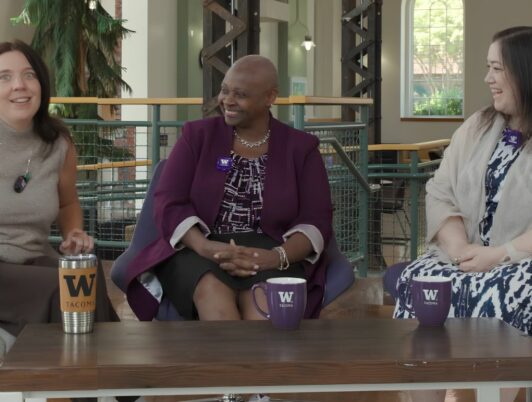
Host Marguerite Martin: Hi, I’m Marguerite with Move to Tacoma, and I’m here today with Sheila Edwards Lange, the Chancellor of the [00:01:00] University of Washington Tacoma. Hi, Sheila. Hi. And, uh, Amanda Figueroa, who is the Vice Chancellor of Social Mobility for the- Yes … university.
Amanda Figueroa: So close. Associate Vice Chancellor.
Host Marguerite Martin: Associate Vice Chancellor of Social Mobility. Yes.
Producer Doug Mackey: These are some good titles.
Host Marguerite Martin: Yes. Yeah. So we’re here today to talk about kind of the university’s role in Tacoma, but also, if it’s okay, I mean, I’d like to talk a little bit about, like, why go to college- Yeah … in 2026? Like, what is the opportunity? Like, there’s so much discussion about, like, “Don’t go to college.”
Like, it’s, you know, it’s, I feel like all the billionaires are telling us not to go to school. What’s that about? Yet
Chancellor Sheila Lange: they send their children.
Host Marguerite Martin: Yes. Yes. Okay. So that’s what we’re gonna talk about.
Chancellor Sheila Lange: Like-
Host Marguerite Martin: But before we get down to it, I’d love to know each of you, like, when you moved to Tacoma, and why.
Amanda Figueroa: Okay.
Chancellor Sheila Lange: Well, you’ve been here longer.
Amanda Figueroa: Oh, uh, uh, I’ll start.
Host Marguerite Martin: Okay.
Amanda Figueroa: Uh, so I have worked at University of Washington Tacoma for 14 years, and I moved [00:02:00] here 13 years ago. Uh, and I started in New Tacoma, and then in 2018 was able to buy a house on the east side. Oh, cool. Uh, and so I love the east side of Tacoma. Um, I am really close to Stewart Heights Park.
I love to walk around the park. Uh, I’m always getting hot tortillas at La Huerta, too. Um, love the neighborhood.
Host Marguerite Martin: You, okay, you’re anticipating my next question- Yes … which is like, what’s your favorite spot to go? Like, where do you tell people to go? Oh. And you said Stewart Heights Park- Oh, yeah … and La Huerta.
So where, where else do you like to go?
Amanda Figueroa: beware Coffee, I have to give a shout-out. Oh, yes. Yes. I love that coffee shop. They’ve got great coffee, and it’s such a great community place. I feel like I always run into people- Mm-hmm … no matter what I’m wearing.
Host Marguerite Martin: That’s Tacoma for you.
Chancellor Sheila Lange: Yes.
Amanda Figueroa: So that’s a, it’s a wonderful neighborhood.
Chancellor Sheila Lange: That’s awesome. So I moved to Tacoma in September of 2021- Okay … so five years ago. And, and moved to the Proctor area. Okay. And love, love it. Um, very close to everything. [00:03:00] My first year was in Proctor, and then two years after that in Point, at Point Ruston.
Move to Tacoma Jingle (Doug Mackey): Oh,
Chancellor Sheila Lange: really? It felt like I was on vacation. Every day
Host Marguerite Martin: Okay, I have
Chancellor Sheila Lange: to ask you
every day like com- come home, it’s like there’s restaurants, there’s the theater. Yes. There’s walking trails. Yeah, it, it felt like vacation.
Host Marguerite Martin: You are the very first guest we’ve ever had that has ever lived in Point Ruston. Oh. So you have to, you have some heavy lifting to do. You have to talk about it some more.
Oh. Like, what is it really like to live there? Like, did you have parking? And like, how, where did your friends park when they came to visit you? Sorry, we have to go off course just a little bit. I’m so nosy. What was it really like?
Chancellor Sheila Lange: So, um, the parking was an issue because people have to pay for parking- Right
when they come to visit you. Right. But there’s plenty of it. Yeah. So that was not an issue. Um, and I had parking in my, I had two parking stalls in my, um, apartment building- Nice … that I lived in. And it was just, like I said, I felt like I was every day driving home, like, “I’m going to my resort.”
Host Marguerite Martin: Yeah.
Chancellor Sheila Lange: The only thing, the train.
The train noise is consistent.
Host Marguerite Martin: Little,
Chancellor Sheila Lange: little- [00:04:00] And, yeah Yeah It’s like every night, like every 20, 30 minutes- Like a big clunk when they go through there … there is a train constantly going through- Yeah … there, and you hear it.
Host Marguerite Martin: Other than that, vacation vibes.
Chancellor Sheila Lange: Vacation vibes. Okay. I mean, lots of shopping, um, just beautiful restaurants.
Everything’s on the waterfront. Walk right out of my door to go for walks along the waterfront.
Host Marguerite Martin: Did you really do that? I
Chancellor Sheila Lange: did. Did you really go for waterfront walks in Ruston? I did. I did. I did.
Host Marguerite Martin: Oh, it, it looks like a dream. Yeah. But I’ve never lived down
Chancellor Sheila Lange: there. It is. It is. It is. Mm. And then eventually I, um, ended up moving, um, back to West Seattle because my husband works in Ballard.
Host Marguerite Martin: Oh.
Chancellor Sheila Lange: And-
Host Marguerite Martin: That’s tricky.
Chancellor Sheila Lange: Yes. And so he, the t- the commute for him back and forth, he decided he was not going to do that anymore. So West
Host Marguerite Martin: Seattle was the compromise.
Chancellor Sheila Lange: Well, we had a, a place in West Seattle- Oh, I see. Okay … ’cause I came from Seattle.
Host Marguerite Martin: Okay. Got it. Got it. So what is it like for you to get to Tacoma from West Seattle?
Like, is that a, you drive into UWT?
Chancellor Sheila Lange: I do. I drive in every day. It’s, um, about 35 [00:05:00] minutes. It, um- And it’s a reverse commute, right? It’s a reverse commute. Rarely, rarely do I have traffic.
Host Marguerite Martin: Mm.
Chancellor Sheila Lange: Okay.
Host Marguerite Martin: So yeah. All right. That’s good insight for the people.
Chancellor Sheila Lange: Mm-hmm.
Host Marguerite Martin: So I’d love to talk a little bit about what is social mobility- Mm-hmm
and what, what is UDub trying to do when we talk about social mani- mobility for students, and then we can get into the existential crisis around sc- unless should we start with the existential crisis around
Chancellor Sheila Lange: universities? No, let’s, let’s, let’s talk about social mobility- Yeah … ’cause I d- I think it ties into why students need to go to some kind of post-high school schooling.
Yes. So whether that’s, um, I think when people talk about college they’re, they’re talking about, you know, $100,000 a year, four-year liberal arts, and-
Host Marguerite Martin: Exactly
Chancellor Sheila Lange: what
Host Marguerite Martin: my mind is thinking.
Chancellor Sheila Lange: Right. Yes. And, and when I think about, um, college, I think about everything from apprenticeships to trades to short-term certificates- Mm-hmm
to a private liberal arts college. I mean, there- Okay … it’s just a, a long continuum of opportunities that students have. Mm. So University of [00:06:00] Washington Tacoma, if you back up, we just celebrated our 35th anniversary, um- Okay … of our founding, so that’s very in, in important to us. Because this university was actually founded, um, on the premise that if a university were in our community, we would have opportunities for our students to get access to education, and they would become part of the workforce.
Yes. The university and the students would contribute to economic development in the area, and then we could become partners to growing what happens in the region. If you fast-forward 35 years from now, we talk about that as social mobility. Yeah. We’re, we’re serving students who are from our region who might not otherwise get access to college, and that access to an, an, a degree here at UWT- Provides them the tools to get a living wage job- Mm-hmm
which is what social mobility is all about.
Host Marguerite Martin: Can I ask, a living wage job is how much money?
Chancellor Sheila Lange: So I should know that dollar amount. Yeah. Do you know that dollar amount? It depends
Amanda Figueroa: on where you [00:07:00] live.
Host Marguerite Martin: Right. I think
Amanda Figueroa: it’s,
Chancellor Sheila Lange: right,
Amanda Figueroa: so it’s a complex answer.
Host Marguerite Martin: Yeah. Right, and in our area, do we know, like, roughly, is that, like…
‘Cause I think, like, minimum wage now is, like, $17 an hour-
Chancellor Sheila Lange: Yeah …
Host Marguerite Martin: which is probably not even enough to get, like, a one-bedroom apartment- Right … on your own. And then, you know, to my mind, because I’m 47 next month, like, I think like, “Well, I mean, like, $60,000, that’s, like, a lot of money, right?” Mm-hmm. But it’s not anymore.
Right. Like, oh, I, w- I, I don’t even know what a good-paying job is in 2026.
Chancellor Sheila Lange: Well, it’s definitely, living wage is, is, it helps. Mm. But it is not enough if you’re trying to raise a family. If you’re a single person, it’s probably all right.
Host Marguerite Martin: Right.
Chancellor Sheila Lange: But if you’re trying to raise a family-
Host Marguerite Martin: You need
Chancellor Sheila Lange: at least two of them
you need at least two of those to be able to afford, um, housing. And Amanda talked about being able to buy a home. Yes. Buying a home is out of reach for so many people- Mm-hmm … um, these days. And so you have to think about what will it take for me to be able to not only afford my apartment today, but save towards some kind of [00:08:00] future, um, tomorrow?
And, and I’ve heard 70,000, um, is around that number.
Host Marguerite Martin: That sounds right. Yeah. And like, I think they say the, the median for Pierce County right now are, the household income is about 80,000. Mm-hmm. So that’s, and that’s probably two earners- Mm … most of the time. So- Yeah … that seems about right in the middle.
Mm-hmm. But as you say, that’s not enough to buy a house in Pierce County. Like, our average home price is, I think, $550,000 right now. So it’s obviously, going to university doesn’t fix the whole system, but it gives you the best shot at getting on the ladder, right?
Amanda Figueroa: Yes. Yeah. And I think that, um, you know, we want simple answers, and we want numbers associated with social mobility- Yes, give me as many social- And that-
simple
Host Marguerite Martin: answers
Chancellor Sheila Lange: today
Host Marguerite Martin: as possible.
Chancellor Sheila Lange: Yeah.
Amanda Figueroa: And that makes sense, but I really like a definition that has been developed through a group called Mathematica in their Education to Workforce framework, and they talk about economic security.
Chancellor Sheila Lange: Mm.
Amanda Figueroa: And they talk about attaining the ability to maintain agency and autonomy over your life, and that’s gonna look for different, different for different people based on where you’re living, uh, how [00:09:00] many family members you have, um, if you prefer to rent or if you prefer to buy- Mm
because, um, y- you know, it really just depends on what you value, and do you have enough of an education and enough choice within the workforce and the available jobs to be able to do what you want with your life?
Producer Doug Mackey: Mm.
Amanda Figueroa: And I think a lot about agency and autonomy, and the dignity that also comes with being able to have that choice, and being able to try on hard things.
And maybe you don’t make as much money as someone in a different profession- Mm-hmm … but you’re so fulfilled, and you’re so connected, and you’re doing what you want to do creatively. Mm-hmm. And that really matters, to be able to give people choices.
Move to Tacoma Jingle (Doug Mackey): Mm-hmm.
Amanda Figueroa: And I think that’s what UW Tacoma contributes to, is that ecosystem of helping folks decide, what do I think is success for myself?
Mm-hmm. How do I attain positions and responsibilities or create new kinds of jobs and new economic sectors for our community that allow me to help shape the kind of [00:10:00] community that I value and that I think is important?
Chancellor Sheila Lange: What she said.
Host Marguerite Martin: Okay. Well, I’m imagining, like, you kinda have a, you know, a, a, as a real estate person, like, I often think about, like, ideal clients and, like, these different individuals that might be listening.
And for you all, I imagine there’s the recent grad or the soon-to-be high school graduate. But there’s also an adult learner that’s maybe returning to school after a little time in the, in the workforce, or maybe somebody who’s been in the workforce a long time who’s making a career change. How do you speak to these different segments about, like, the value of university and also, like, UWT in particular?
Like, how does that work? ‘Cause I think that there’s a lot of resistance right now. It’s like, “Well, I’m gonna spend all this money, and who knows- Yeah … if that leads to more skills or if that leads to a better network or…” What, what is the, what is the case for college right now?
Chancellor Sheila Lange: So I’ll back up a little bit and say that the mix of students at UW Tacoma is, is, is pretty unique.
So, um, about half of our students are community college transfers, and half are [00:11:00] direct from high school. Mm. So what we find with those community college transfers, they, um, for the most part, um, are older. They’re more focused. Um, some, some are coming after spending years in the workforce, um, some are coming to retool or, um, skill up.
And so those students have a very clear idea about the value of this college degree and what it is going to do- Mm-hmm … for their, um, either, as, as you said, their lifestyle and what they, their, what they wanna do with their life or their earning potential.
Move to Tacoma Jingle (Doug Mackey): Mm-hmm.
Chancellor Sheila Lange: I think it’s harder with, um, direct from high school students ’cause many of them, they have a general idea about what they wanna do.
Yeah. They’re not always clear on, um, how the deg- degree that they are pursuing or even what degree they wanna pursue- Mm-hmm … is going to connect to, um, what they do after college. That
Host Marguerite Martin: exploration is part- Right … of the process, right? Right. You want them to explore as
Chancellor Sheila Lange: well.
Host Marguerite Martin: Yes, yes. But …
Chancellor Sheila Lange: But we wanna give them knowledge.
And so some of the work [00:12:00] that, um, when, when Amanda’s title changed, what, three years ago? Mm-hmm, three. Um, it was really, um, shift, signaling a shift at UW Tacoma to focusing not only what happens to students while they’re here, but also thinking about, how can we better prepare them for whatever career it is that they aspire to?
Whether it is, um, giving them exposure to different careers in their, um, gr- Um, degree path, um, having them think about, um, short-term internships, what we call micro, um, internships- Mm-hmm … which are less than four weeks, where you can get a sense of what you wanna do. Mm. And I will say I had two of those, um, they weren’t called micro-internships, but two experiences myself as an undergrad that led me to say, “Okay, yeah, I don’t wanna do that.”
So That’s
Host Marguerite Martin: very helpful. Yeah. And in only four weeks, that’s really
Chancellor Sheila Lange: efficient. Yes, yes, yes, yes. And, um, and, and sometimes it’s important to know what you don’t wanna do- Yeah … um, because then it, it, it steers you more towards, um, the kinds of things that you want from [00:13:00] work and, um, how you want your life to be.
So, um, I, I did a, a internship at EF Hutton. I don’t know if… I don’t, it d- I don’t think it exists, but it was a financial, um, advising firm. Hmm. And I hated it. And it paid really well. Yeah. I mean, really well. But it also told me that I didn’t really like, like, working with people to try and convince them to give their money to- Yes
a particular fund-
Move to Tacoma Jingle (Doug Mackey): Yeah …
Chancellor Sheila Lange: um, and trying to get them to invest in p- in particular things That’s great experience. We’re doing more of that here at UWT, um, under Amanda’s leadership, just having students think about, “What am I going to do after I get this degree?” And that’s where the value of the education comes in.
Mm-hmm. And if a student knows, um, and the, it’s, this is consistent in the research, if a student knows what they’re going to do with that degree, they’re more likely to persist- Mm-hmm … and, um, um, finish that degree- Makes sense … because there is, um, an endpoint, there’s an endgame, um, that they [00:14:00] know is waiting for them after they finish that degree.
Amanda Figueroa: I also like to think about how much our economy has changed over the last 50 years. So when I think about the kinds of jobs that existed 50 years ago versus the kinds of jobs that started to be created four or five years ago-
Chancellor Sheila Lange: Right …
Amanda Figueroa: versus what is that rate of change going to be in the next five, 10 years?
Move to Tacoma Jingle (Doug Mackey): Mm-hmm.
Amanda Figueroa: We have really evolved from, uh, an agrarian and manufacturing economy into more advanced manufacturing research development service.
Move to Tacoma Jingle (Doug Mackey): Mm.
Amanda Figueroa: And when we look at the kinds of jobs that are projected to be created in Washington State, and across the country and the world, then we see that developing those kinds of liberal arts outcomes that, uh, uh, education like UW Tacoma provides- Mm-hmm
really helps folks to not only get the jobs that exist now, but develop the kinds of skills that can support their career mobility over their entire life.
Host Marguerite Martin: Okay, so Amanda, you are speaking to my anxieties right now. Yes, I know it. Because, uh, I’m a doom scroller. [00:15:00] Yes. Mm-hmm. And, you know, it’s late night and I’m on TikTok- Yes.
and the, the whole world is ending, right? Yes. Like, AI is gonna, like… And I think it’s, it makes so much sense. We’re going through some kind of technological explosion. Yes. Like, jobs are gonna change, roles are gonna change. Yep. But, you know, like I, I have a job where I have to take care of myself. Yes. And that idea of like, okay, the, the, the wor- the work landscape for the next 25 years won’t look like it looked for the last- Mm.
20, you said the last 50.
Chancellor Sheila Lange: Yes.
Host Marguerite Martin: Yeah. So what is it you’re really learning? Are you learning to learn? Are you… A- a- and at the same time, we have these tools that seem to be, like, making it really easy to not think. Mm. Like, how, what is happening? You know- What are we doing?
Chancellor Sheila Lange: I would actually argue, though, that the AI tools, um, require that you think more- Yes
because you actually have to be more discerning about what you are getting from AI, um, understanding, um, you know, source material- Mm … which is what we teach, you know, students, um-
Amanda Figueroa: [00:16:00] Yes …
Chancellor Sheila Lange: um, consistently across all majors. What is a source?
Amanda Figueroa: Mm-hmm.
Chancellor Sheila Lange: Is it real? What are citations? And so, um, you actually have to think more using AI, ’cause you could just take what it gives you- But there’s a lot of errors.
There’s a lot of made-up stuff in there. Absolutely. What, I think they call it hallucinations.
Host Marguerite Martin: Yes.
Chancellor Sheila Lange: And so you actually have to think more strategically about what you are seeing and dig deeper into what you get in order to discern whether it’s true or not.
Amanda Figueroa: Mm.
Chancellor Sheila Lange: And so it does require more thinking. And I…
You know, when people say, “Oh, AI’s gonna take human jobs,” I don’t think so. I think it’s gonna change the way humans do our work, but it is not going to replace humans
Amanda Figueroa: I also think that there’s really interesting connections because we have, we ex- we’ve been experiencing, um, perhaps more rapid economic shocks, right?
Yeah. And one of the things that we talk about in career development is the idea about career shocks. Mm. And I think those are likely to continue to happen frequently into our [00:17:00] future, whether that is because of AI or because of climate change- Right … or because of some other technological advancement that I can’t even imagine right now.
Um, and so thinking about the ways in which we help students to understand who they are, what they value, to gain confidence, because one of the things that I see all the time with our students is that they come in with these incredible experiences, but they don’t necessarily understand how to translate that to someone else- Mm
to be able to s- communicate it in a way that other employers will understand and be able to connect to how that can help them to advance their work.
Chancellor Sheila Lange: Right. Mm-hmm.
Amanda Figueroa: And having students open up their mind about what are the possible careers in this world, because when I think, you know, growing up as a first-gen professional myself, I had a very limited understanding of the kinds of careers that were available to me.
Host Marguerite Martin: Whatever was on, like, the third-grade chart- Yes … like doctor.
Amanda Figueroa: Yes. Or what I [00:18:00] saw- Astronaut … on TV.
Host Marguerite Martin: Yes.
Amanda Figueroa: Or who was in my family. Right. Right? And so to come and to engage with such an incredibly diverse community of other students, of other faculty, of staff, of scholars who are visiting us from all over the world, and then to have access to that kind of ability to expand your horizons expands your imagination and understanding of what is possible for yourself.
Um, and I really love this framing that is, um, that was created by one of our professors, Dr., um, Chris Beasley, about this idea about possible selves.
Chancellor Sheila Lange: Mm.
Amanda Figueroa: And I think that’s what higher education really invests in, is how do we support folks in imagining who they can be and then understanding how to get there and developing a really solid skat of, set of power skills that are going to help them to get to wherever they th- they want to get to for the next phase of their life.
We were just talking about AI and how AI is writing for people, but to Chancellor Lague’s point, you have to be able to discern, is [00:19:00] this good?
Host Marguerite Martin: Yeah, no, you can tell- … if somebody just lets AI write for them. You
Amanda Figueroa: sure
Host Marguerite Martin: can.
Amanda Figueroa: You sure can tell.
Chancellor Sheila Lange: You sure can. You sure can. Yeah. And you can also, um, tell if you have not done the, the background work.
So we are, we were looking at governance models and, you know, we asked AI and it told us, “Oh, University of Michigan is doing this.”
Producer Doug Mackey: Mm.
Chancellor Sheila Lange: It’s like, okay, so Looking at University of Michigan, trying to s- find out where this is happening. It is not happening. AI made it up. Oh my gosh. So you really have to ask the- Double check
the first and second question about, okay, is this happening? If so, who is doing it, and where can I find evidence that it’s actually happening? And, and in terms of how we’re… People always ask how we’re incorporating it. We’re teaching students to ask those kind of questions- Mm-hmm … about everything, even about articles that they’re reading- Mm-hmm
that, that aren’t written by AI.
Host Marguerite Martin: Mm-hmm.
Chancellor Sheila Lange: To just have those critical thinking skills, um, to [00:20:00] be able to ask questions about whatever is in front of you, um, whether it’s about its validity, but also about its relevance to your own life. Mm-hmm. And I think that’s what college
Amanda Figueroa: gives
Chancellor Sheila Lange: you, um, that you don’t get, um, if you don’t have some kind of post-secondary experience after high school.
Hmm.
Amanda Figueroa: It also is an opportunity to expand your, uh, your professional networks So when I think about the opportunities that we provide for students to do things like study abroad or to take part of those micro internships or our summer social justice internships that we do- Mm-hmm … um, or the industry-based projects that happen in our classroom, students are building networks with each other.
They’re building networks with faculty. Um, we are designated as a community-engaged campus, and so there’s a whole mapping exercise we’ve done to understand all the different ways UDub Tacoma is connected to community, and all of those things [00:21:00] feed into helping students to develop career-aligned social capital.
Hmm. So how do I find those networks of people who are already doing work that I’m interested in exploring or that I’ve identified I definitely am interested in doing this? And it provides those entry points for them to develop those relationships. It is so wonderful as a student to be able to reach out to a professional on LinkedIn and say-
Host Marguerite Martin: Right
Amanda Figueroa: “I’m a student here. I see that you’re also a Husky, or I see that you’re in our community. I would love to chat with you for 20 minutes over Zoom to learn more about who you are and what you do and how, how you got there.” Hmm. And this is a plug that we do need more folks engaging in this way.
Move to Tacoma Jingle (Doug Mackey): Yeah. Yeah.
Amanda Figueroa: So this is where any community member can really support, um, any student in higher education in Tacoma. Um, but it, it gives you structured ways to engage in those kinds of practices, um, and it takes a lot of some of that work that you might have to do on your own, figuring it out, trial and error. Mm-hmm.
And it, [00:22:00] in many ways, it’s like a shortcut, and what we do know from studies of higher education is that if you get … The more education you have, the more money you make over your lifetime- Hmm … the less unemployment you experience, um, the better your health outcomes are. There’s a, there’s a whole plethora of really positive outcomes that come from engaging in education.
Now, you have to be smart about it, and I also think it’s really important to understand that with where we are in our society, there is no such thing as being done with learning. It just doesn’t happen. If you’re going to be healthy and happy and have choice in our society- Right … you’ll always be learning.
And so this idea about building an education on a schedule that works for you is part of why I think UW Tacoma has such a special place in the Tacoma area, because we, we see students directly out of high school. We see students directly out of Running Start. We see students directly out of community college.
But our average age of our student is 26 [00:23:00] years old.
Host Marguerite Martin: Oh, interesting. Okay.
Amanda Figueroa: 19% of our students are connected to the military.
Host Marguerite Martin: Okay.
Amanda Figueroa: We, uh, have a m- m- most of our students are first in their family to earn a four-year degree.
Host Marguerite Martin: Mm-hmm.
Amanda Figueroa: So this really is an engine of opportunity, and we work hand-in-hand with our community colleges, um, and our high schools.
Um, and I really, one of the things I appreciate, um, about Chancellor Lang’s leadership is that she’s really engaged in community. So she’s engaging with K through 12 schools, she’s engaging with community groups, and she’s helping to understand what role can higher education play to support you and your community goals.
Mm-hmm.
Chancellor Sheila Lange: And I will say that’s one of the things that I also loved about moving to Tacoma- Mm … is that there is an ecosystem here in Tacoma that works collaboratively. So when we talk about, um, college access, uh, the need for college, um, a college degree, and I always say, you know, it could be a four-year liberal arts.
Host Marguerite Martin: Mm.
Chancellor Sheila Lange: We actually have two liberal arts universities right here in Tacoma. Mm-hmm. It could be a s- a community or technical [00:24:00] college. We have four community- Yeah … technical colleges here in, um, in Pierce County. Or it could be, you know, a more traditional four-year university experience like here at UWT, or even a non-traditional four-year university experience like Evergreen Tacoma offers.
Mm-hmm. So the ecosystem of what we have to offer here in Pierce County and Tacoma, and for anyone who wants to pursue a post-secondary credential, is it’s, um, rich and connected, and I think that if someone comes to Tacoma, you get something u- unique and special here.
Host Marguerite Martin: I love that. This is a good, a good place to put for us to go to our break, but then I wanna, I wanna come back and start there.
Amanda Figueroa: This is Marguerite from
Host Marguerite Martin: movetotacoma.com, and I wanna thank UW Tacoma for their sponsorship of Channel 253. As a longtime downtown Tacoma resident, University of Washington Tacoma is one of my neighbors, and they’re adding more downtown [00:25:00] Tacoma residents each year to this growing campus. This past year, UWT celebrated 35 years and 35,000 graduates, which is a pretty big milestone for this university, this community, and these students.
Many thanks to the Tacoma Huskies for your support of Channel
Producer Doug Mackey: 253 and for being an important part of downtown Tacoma life.
Host Marguerite Martin: We are back with Chancellor Sheila Edwards Lange and Amanda Figueroa, and we’re talking about social mobility and education here at the University of Washington Tacoma. And we were just kinda starting to dig into how well-connected the education community is here in Tacoma, and how that creates opportunities for students.
I’d love to learn- More about like if you come to UWT, obviously you have a lot of different programs, but within this region, like can you say more about that? Like what are the opportunities when you pursue education here at UWT?
Chancellor Sheila Lange: You know, I, I think it’s, it’s interesting for a student to [00:26:00] get the information that they need about the type of institution that they should enroll in.
Because I talk to students and they’re like, “Well, I wanna be a radio tech or something.” Yeah “Or a lab tech and, and do ultrasound.” I’m like, “You know, we don’t have that here at UDub Tacoma.” Yeah. “But you could get it at TCC or Bates.” Right. And so that, um, ecosystem allows us to have students go to the school that makes the most sense for them.
Host Marguerite Martin: Mm-hmm.
Chancellor Sheila Lange: Once they decide that UWT is for them, then we’re gonna do everything we can to provide them with career exploration, um, opportunities, internship opportunities, um, to explore that career path further and how it connects to the education that they’re getting in the classroom every day.
Host Marguerite Martin: How common is it, whether you’re 18, right out of high school, or 26 coming back or transferring from one of the community colleges, how common is it to know exactly what you wanna do and then do [00:27:00] exactly what you said you were gonna do?
And how often is it that people are coming in and then maybe going on a winding path? Like what is, what is… Is there, is there a normal, is there an average or is everybody kinda doing their own thing?
Chancellor Sheila Lange: There is no normal.
Host Marguerite Martin: Okay. Good to know.
Chancellor Sheila Lange: There is-
Host Marguerite Martin: Good to know.
Chancellor Sheila Lange: You know, everyone has their own path on their own time.
Mm-hmm. And those experiences that they get along that path actually prepares them for where they are right now. Mm. So I have students that say, “Oh, I, you know, I took too long.” And I’m like, “No, actually, the experiences that you’ve had, whether it was even working, um, in a low wage job-” Mm … gave you the experience that you need, that you can actually bring that experience to the classroom- Mm-hmm.
Right … and enrich the learning environment for everyone, because you actually have real life work experience A lot of students don’t, you know, especially 18-year-olds. Mm-hmm. So, um, it, every s- every student takes their own path, and we talked about our military-connected students. One in five here are military-connected, which means we have a [00:28:00] lot of students who are either veterans themselves, spouses of veterans, or dependents of veterans.
And, you know, m- m- for spouses, they’ve moved all over.
Host Marguerite Martin: Right.
Chancellor Sheila Lange: And so trying… For them, the story has always been trying to accumulate enough credits to get towards a degree.
Host Marguerite Martin: Yeah.
Chancellor Sheila Lange: For a veteran, they’ve been, you know, basically in the workforce for, for the amount of time that they’ve been deployed, and they’ve been trained to do a specific thing.
Now, they may, um, veer a little bit and try and, um, do something connected to what they were doing in the military, but often they’re coming and just exploring a whole different idea about- Yeah … what they wanna do post-military. So every student’s journey is so different.
Host Marguerite Martin: Oh, that’s so interesting.
Chancellor Sheila Lange: And that’s the normal.
Host Marguerite Martin: That, and that’s normal. It’s normal that you don’t know exactly what you wanna do the day that you show up and you do exactly… Like, I feel like that, that was always what I thought happened in college, is like you pick from the menu of, like, your life plan. That, those days are gone.
Amanda Figueroa: Yeah, and I, I think that a lot of folks still hold, like, [00:29:00] a 1940s, 1950s vocational kinda framing in their minds, where you start in a job, you work at that company your whole life, and you retire.
They hand you a watch or something, and then you move on. Um, but we know that students and people in the workforce now are changing jobs five to seven times over their lifetime.
Chancellor Sheila Lange: Right.
Amanda Figueroa: And that’s why I talked about career adaptability and being able to overcome career shocks, because that will continue as we move into the future.
Host Marguerite Martin: You said a phrase earlier about, um, like the connections that you make when you- Mm-hmm … go to col- what was that phrase you said?
Amanda Figueroa: The career-aligned social capital.
Host Marguerite Martin: Career-aligned social capital. Yeah. So, I mean, I, I think there is some part of me that’s… Okay, so I didn’t- I should have probably said this at some point.
Like, I have, like, 60 credits from various community colleges, but I’ve never finished my degree. I have, like, a professional certification, right- Yeah … to be in real estate. But, like, uh, uh, when I think about going to college and having a, what I imagine from the outside to be a traditional college [00:30:00] experience, it’s like you’re buying a network.
Mm. Mm. Which is a, a terrible capitalist way to look at it, right? Mm. But that’s what I heard when you said that, is it’s like it’s not just, “I’ve learned to do X, Y, Z, so now someone’s gonna hire me to do this.” It’s, “I now have all these connections,” like you were saying, “with my peers, with the faculty, with the people that I had internships with, and now those people, whatever the job market does, are gonna help me find my next thing.”
Is that, like, an innocent way to look at it, or is that really how it works, even here in Tacoma?
Amanda Figueroa: That is really how it works.
Chancellor Sheila Lange: Yeah. And the reason that private elites like Harvard and Penn- Yeah, yeah … are so succ- successful is because of that network. Yeah. That, you know, that, that students, they, they meet peers who will become the entrepreneurs and leaders- Mm-hmm
and they become part of that network. And there’s also this thing that happens, I, I really love the way Amanda framed it earlier, about the joy and, and value and what kind of life you lead. Mm. I met my, my closest friend my freshman year in [00:31:00] college. Oh. We are lifelong friends. Mm. I mean, this is what it’s…
So 46 years- Wow … of friendship. Our, our families have grown together, and we were completely different. I mean, when I first met her, I thought, “This girl-” chick is just totally not- Yeah … someone I wanna spend time with, ’cause she was like the total opposite of me.
Host Marguerite Martin: Yeah.
Chancellor Sheila Lange: But she is like my best friend. Mm. And so not only do you get those peers who help you in your career along the way, um, you get peers who become lifelong friends and supporters, and it just so happens she works at Stanford, I work here.
Um, so we work in different- Mm-hmm … um, s- situations. But, um, we’ve just through our careers, um, stayed connected.
Host Marguerite Martin: Well, and what makes me curious about that is back to social mobility, you know, like, um, uh, we now, one of my nieces is the first person in my family line to get a college degree. But, um, you know, not coming from a background of people who expect you to go to a school- Yes
and within the school, you go to one of these schools. Right. [00:32:00] Mm-hmm. You, when, I imagine when you go to a university, you’re automatically mixing people, with people who have a completely different social paradigm of like what is normal- Yes … what is rich- Mm-hmm, mm-hmm … what is successful. Yep. And that cross-pollination is important.
But I think the question people would have is like, “Well, it’s Tacoma. Like how much, how much cross-pollination are you gonna get in Tacoma?” And so that’s my question.
Chancellor Sheila Lange: There is a lot of cross-pollination- Okay, here we go … in Tacoma. Yes. I mean, you look at just the variety of schools that we have here. So we have private elite- K-12 schools like Bellarmine and- Mm-hmm
Annie Wright and Charles Wright. And then you have our public schools like Tacoma Pub- um, Public Schools, and, and the surrounding ones in Pierce County. I think about Franklin Pierce District, for example. All of those students come here with different lived experiences and what they’ve done. I remember as a first-gen student myself going to college and sitting in classes with students who, you know, like, went on vacations.
And I’m like- Yes … [00:33:00] “I had no concept of a vacation.”
Host Marguerite Martin: Yes. Do you know people summer? Yeah. Have you heard about
Chancellor Sheila Lange: that? Yes, as a verb.
Host Marguerite Martin: I’ve heard about that.
Chancellor Sheila Lange: Yes. I mean, really, I had no idea. I had no idea that there are incredibly wealthy Black people in, and that there were free- Yes … Black people in the US- Yes
who were in- or who are now generations of free people who have this legacy of intergenerational wealth. And I was like- Yes … “Wow.” That’s something I found out when I went to college. Uh, because you’re sitting in classrooms with people who come with all these different lived experiences. Mm-hmm. Um, and I, I think- Assumptions
uh, yeah, and assumptions and, and knowledge about the world. I think that’s what makes- Yeah … um, our classrooms so interesting, when you get that… When we’re teaching, um, students to work in teams, they’re working in teams with students who have very different back- lived- Yeah … backgrounds and experiences than they do.
And so you learn how to work and, um, across differences in, um, effective ways.
Amanda Figueroa: Yeah. [00:34:00] We, uh, so I work in student affairs, and we just had our retreat on Tuesday, and we always include a student panel in our retreat. Um, and it always makes me smile because one of the students talked about how much they dislike group work.
But-
Host Marguerite Martin: Relatable.
Amanda Figueroa: Yeah. But the reality is, like, I don’t know anybody who works completely by themselves in isolation. If
Host Marguerite Martin: only. Yeah, yeah. No, there’s other, other people, other people are a thing forever.
Amanda Figueroa: With different perspectives- Mm-hmm, yes … and different life experiences, and different world views, and that’s one of the, the pieces behind that skill about working with diverse teams and developing communication skills.
Chancellor Sheila Lange: Mm-hmm,
Amanda Figueroa: mm. So when I also think about social mobility is, as I’ve been in this role for the last three years, I certainly think about the economic return on investment. Mm. But I’m also thinking about those pieces about, like, dignity, and sense of purpose, and human flourishing, which I think is a really critical part of social mobility that is not getting as much attention, um, because it’s not as easy [00:35:00] to quantify- Yeah
and it’s not as easy to measure. But I also think about the roles that higher education plays in helping to ensure we have a healthy and thriving democracy.
Host Marguerite Martin: Mm, mm.
Amanda Figueroa: So being in an environment in which you are exposed to different ways of thinking, where your n- where your learning in your classroom is not defined by algorithms that feed your engagement.
Right. Right? But instead is really pushing you to think differently, to consider different perspectives, and then how that helps you to show up not only in a work environment, but how it helps you to show up in your neighborhood, how it helps you show up in your community, how it helps you think and reframe the lived experiences.
Because your life experience, your life experience, and mine are all vastly different. Mm-hmm. And we are three individuals in a community, and a state, and a country of millions. So- Being able to engage in that kind of skill set- Mm-hmm … also supports our ability not only to help [00:36:00] individuals with their social mobility, but helps us to connect and create an ecosystem within our own community that supports a different kind of thriving and mobility that engages more people in the great experiment of America, and helping us to determine what kind of future do we want.
Yes.
Chancellor Sheila Lange: Okay. And f- Yeah … and I would even add, it helps us in how we show up in our families. Yes. Okay. Um, because that has been, for me, the, um, as a first-gen college student, the most transformative. And, and you mentioned you have a niece who’s first in family.
Host Marguerite Martin: Yep.
Chancellor Sheila Lange: So, um, because I’m first in my family, the expectation with all my nieces and nephews was, “Where are you going- Right
after high school? What are you doing?” The whole narrative changes. It, it did. Yes. It did. So you know, it’s like, uh, I’m like the pushy aunt in the family now. Mm-hmm. I’m like, “Well, what are you doing?” Mm-hmm. You know, “What’s your what’s your career trajectory? What are you thinking about doing?” Um, so asking all of those kind of questions to my family.
Host Marguerite Martin: Yeah.
Chancellor Sheila Lange: The health… We talked about, um, education as a social determinant of health- Mm-hmm … meaning you have [00:37:00] better health outcomes- Mm-hmm … because of a college education. ‘Cause I learned how to ask the right questions. You know, when someone in the family is dealing with some kind of illness, I’m the one who’s asking really critical questions about, “Have you thought about this?”
Mm-hmm. “Have you talked to this person? Have you used this resource?” ‘Cause I’ve learned how to, um, identify resources in college. Right. And so, um, always- And maybe
Host Marguerite Martin: you have a network, maybe you can call a friend- Mm-hmm, mm-hmm … that has access to that information.
Chancellor Sheila Lange: Yep. But it really does, it changes the family dynamics.
It, it changes how you show up in community and your workplace, but it also changes how you show up in your family.
Host Marguerite Martin: Okay. I wanna ask you a slightly impertinent question. Yes. I wanna talk about money a little bit with this, because y- you know, as you were ta- it was, it triggered, I was triggered a little bit when you talked about, like, well, what about actually, like, having your values reflected- Yes
in your life and being a part… I’m like, “Oh, that sounds like rich people stuff.” And you know, like, I was thinking, like, how much does it even cost to go to college now? I don’t actually know how much it would even cost to go to UWT, and I don’t [00:38:00] wanna get all, like, “What’s the ROI?” But the fear I have- Mm … with, like, you know, at a systemic level, like, the middle class, I don’t think it’s controversial to say, you know, we’re losing our middle class a little bit.
Mm-hmm. Right? Okay. So there’s more people with less. Mm-hmm. And so it’s like, okay, you’re gonna make this huge investment so you can have these, like, self-actualizing qualities, but how are you gonna pay the rent? How are you gonna have a job that pays you enough to have secure housing and, like, basic healthcare, right?
Mm-hmm. ‘Cause we’re all kind of fending for ourselves in the system. Yeah. This is where my brain goes. It just starts, like, spi- TikTok spiraling. Yeah. So, like, yeah, how do you, how do you f- how do, how do people advoc- I don’t even know how to… Like, how do you make a good plan for yourself? ‘Cause it’s gonna cost money to do this.
Mm-hmm. Without just putting your… We all have a friend that has a few hundred thousand dollars in student loans and says, “You know, this isn’t w- you know, I’m not getting this back.” Yeah, yeah. Like, how do we prevent that? No. I think this generation is learning from the last generation. Right.
Chancellor Sheila Lange: Well, I think first of all the, the cost of attendance, um, if you ask, um, most families they, they have an inflated view of what the [00:39:00] cost of attendance is.
Host Marguerite Martin: I think it costs about $50,000 a year to go to school, like with your housing and your food plan and your… Okay, it’s not that much. Too
Amanda Figueroa: high. How much does it cost to go to school in Tacoma? It depends on where you go to school. Okay. L- if you go here- Yes … do you guys, do you guys know? Yes.
Chancellor Sheila Lange: I, I don’t
Amanda Figueroa: mean to put you
Chancellor Sheila Lange: on the spot.
Yes. We have-
Amanda Figueroa: How much does it cost to go here?
Chancellor Sheila Lange: We have, um, something that we call the cost of attendance, which is what our financial aid office use, which inc- includes housing, books, transportation, incidentals, and I think the, it’s, we’re at $30,000 now. Okay. Um, yeah. So if you do a four- I know it’s 28,
Host Marguerite Martin: but I think it’s 30
year degree, that’s 120,000 for your entire education.
Chancellor Sheila Lange: But because half of our students here at Tacoma are Pell eligible, and they’re also eligible for state, um, um, support, very few of our students graduate- Are paying the full 30 … with student- that.
Host Marguerite Martin: So,
Chancellor Sheila Lange: and, and-
Host Marguerite Martin: And, um- … a, that’s a Pell Grant, which is like a, a, a federal grant, right?
Mm-hmm. And then what was the other one you talked about?
Chancellor Sheila Lange: Um, the college, um, oh, I always wanna call it the State Need Grant, but it’s now called-
Amanda Figueroa: I think it’s the state [00:40:00] need grant.
Host Marguerite Martin: That’s how I refer to it Some- something from the state. And it’s over. There’s, there’s a fe- there’s federal money. Yes … there’s state money.
Chancellor Sheila Lange: They renamed it- Yeah … but it’s the state need grant.
Host Marguerite Martin: So people aren’t paying the full price most often.
Chancellor Sheila Lange: Uh, uh, not here at Tacoma. Yeah, okay.
Host Marguerite Martin: So it is- That’s good. Thanks for talking about money- Yes, yes … ’cause I think that’s, I don’t think a lot of people… When, uh, let me just tell the story. That when my niece was interested in going to college, ’cause she was living with me after high school, and she went to, like I had done, she went to TCC.
Mm-hmm. And I kinda didn’t think she’d finish, ’cause I didn’t finish. And then one day she was like, “I’m ready to transfer. I gotta figure out where I’m going next.” And, and I had to a- as you said, Auntie, like advise her, except I hadn’t done it. Mm-hmm. And so I was like, “Well, you, you’re definitely only going to a state school.”
Mm. Like, ’cause we don’t have, we don’t have private school money. But then I went to a friend who had kids in college. She’d done the whole tour. She had generations of college graduates. And she was like, “No, you go to every school, and then you see who gives you the most money.” Mm-hmm. Even just something like that, like how do you know that- Yeah
until you’ve lived it? Or are you saying, “Okay, it’s 30, but it’s not really 30,” ’cause you get help. Like, how would [00:41:00] someone browsing the website looking at that number really know that if they don’t have a friend to tell them?
Chancellor Sheila Lange: They don’t, and that’s why we see such low college-going rates. And, and they’re hearing this message, um, out in the ether that is college worth it.
Right. And they think they’re gonna graduate with $100,000 in debt, whereas I think it’s 60% of our students graduate from UDub Tacoma with no debt. And- Wait, wait, wait, wait, wait, wait, wait, wait. Yes. And, and our goal is to have 100%- How- … of our students graduate with no
Host Marguerite Martin: debt … how is that? Because they get help.
Chancellor Sheila Lange: Because they get help.
Host Marguerite Martin: What the heck? And that’s not ju- and th- this, sorry, I’m just thinking this through- Yeah … ’cause I’m a budgeter. Yeah. So they’re not just getting help with covering their tuition or their books, they’re getting help with covering their housing- Mm-hmm … and their transportation- Mm-hmm, mm-hmm
and their food costs, maybe to live on campus- Mm-hmm, mm-hmm … or to live near campus. Mm-hmm, mm-hmm. And they’re still not… That’s amazing.
Chancellor Sheila Lange: Yeah, yeah. Our goal is to have 100% of our students graduate with no debt. And as we’re launching our next campaign, meaning r- fundraising, that is the goal for us, to get to [00:42:00] 100% of our students graduating with no debt.
Host Marguerite Martin: Wow.
Chancellor Sheila Lange: Now, I think what happens, though, is that students, you hear stories about, oh, you know, $100,000 a year in debt. Well, that’s if you’re going to somewhere where the tuition is $60,000 a year. Right. And that doesn’t e- even include housing. Mm-hmm. And there are colleges where the tuition, I told you my girlfriend works at Stanford.
Yeah. The, the tuition there is 60, $70,000 a year, before you even get the housing. Right. So, um, you get a lot of private elite who raise the perception, um for everyone- Yes … that the cost of, of college-
Host Marguerite Martin: And confuse the narrative,
Chancellor Sheila Lange: yeah … it confuses the narrative. That’s why I think it’s important for us to do the work that we’ve done with…
We have something called, um, Pathways to Promise here at, at Tacoma, where we’re working with surrounding school districts on college access work. We work with community-based organizations to try and educate families about what the cost is. What are the different kinds of- Post-high school experiences that a [00:43:00] student can have.
Mm-hmm. Because it’s not just all going to a four-year residential university.
Host Marguerite Martin: Mm-hmm.
Chancellor Sheila Lange: You can go to a CTC. When I was at Seattle Central, our maritime program, it was a nine-month program, and students were coming out of there making $100,000 a year.
Host Marguerite Martin: That’s bananas.
Chancellor Sheila Lange: Yes. Nine months. Wow. Um, we had a program where they were recruiting students before they could even graduate.
We were concerned ’cause it was impacting our graduation rates because- They’re stitching … they were in such demand- Oh, wow … yes, that employers were coming and getting them before they finished their degrees.
Host Marguerite Martin: Incredible.
Chancellor Sheila Lange: And they were, you know… These are v- when I say living wage jobs- Mm … $80,000 to start with- Mm
in our graphic design program.
Amanda Figueroa: Mm-hmm.
Chancellor Sheila Lange: And that was one of those programs that- Yeah … our students were being recruited before they could even graduate.
Amanda Figueroa: Yeah. Mm. And I hear your comment earlier about, well, isn’t that a really privileged question to ask about living with purpose? Well, and I know
Host Marguerite Martin: you’re not saying that, Amanda.
Well- I just mean, like, that’s where my [00:44:00] thoughts go when I- Of course … think about those values. Of course. That, that just seems like rich people stuff.
Chancellor Sheila Lange: Yeah.
Amanda Figueroa: I, I hear you, and I think it’s a false choice.
Host Marguerite Martin: I love that.
Amanda Figueroa: Yeah. I don’t think we have to choose between economic security and thriving, and having a great sense of purpose, and a sense of value in what you do, and what mattering…
Like, what, what it means to you to matter in your career and the work that you’re doing.
Host Marguerite Martin: I just, I just f- I think what I think about it in my friend group is, like, when we have these conversations about folks that went into, like, really meaningful jobs that don’t pay much or don’t have- Yeah … very g- And it’s like it’s such a, it’s such a trick.
And, and I know that’s not exactly what you’re talking about, but it’s like there, there is this thing of, like, yes, I wanna give back, but not at the expense of my family’s- Right … stability. Mm-hmm. Like, how do you, even as a student who’s- Yeah … kind of making their path and looking for the right path for them, how do you balance those two things?
Amanda Figueroa: So you… I think individuals are the only ones that can answer that question for themselves. Mm. Mm. Mm-hmm. But that’s why being able to be in, immersed in an education environment where you can pick up the different ways that different [00:45:00] folks have made paths for themselves- Mm-hmm … where you get support for making a career plan, and you get career advice, and you get real-world experience because, to the example that Chancellor Lang sh- shared earlier, sometimes you think you wanna do something and it pays really well.
I hear this story all the time. And then students try it and they’re like, “I hate it.”
Chancellor Sheila Lange: Yes. Mm. ”
Amanda Figueroa: I hate it.”
Chancellor Sheila Lange: Yeah.
Amanda Figueroa: That doesn’t mean you wasted your time. That means you have a super valuable set of experiences. Yeah. What w- is a disservice is if you’d find that out in the very last quarter that you’re here, or you find it out in your senior year.
Right. Mm-hmm. And so that’s why doing that investment earlier so that you can explore and try things on, figure out what you like, what you don’t like, to then be able to figure… And then, you know, we have professionals here that help you do research about, here is what the average pay for this is for someone who is an early career professional, a mid, and a late career professional.
Mm. Here’s what the projected job openings are for this in this [00:46:00] region, in this state- Mm … in this country. So- Being able to make an informed plan about where you think you wanna go, and then how your education can be leveraged to get you to that space- Mm-hmm … is how we attain that, both that economic mobility and economic security, as well as that sense of, “I really like what I do.”
Chancellor Sheila Lange: Mm-hmm. Mm-hmm. Mm-hmm. When I think about people who make decisions to become teachers or social workers, which are not highly paid jobs, but- And
Host Marguerite Martin: getting harder, th- and getting… Th- it’s not going up right now
Chancellor Sheila Lange: But those folks who stay in it, they do it ’cause they love it. Right. It gives them such purpose- Yeah
and such meaning, and they figure out then how to make it work. It isn’t… You know, you come to the conclusion, “I’m never gonna be rich.” I’ve come to that concl- Mm-hmm … I work in public higher ed, and- Mm. Mm … although I’m higher paid than most people, um, being a college president, I still say I work for a public university.
Yeah. I know I’m never going to be rich. I’m not gonna be s- able to summer in Martha’s [00:47:00] Vineyard, you know, or- Yeah … have a home on another island somewhere. Stay in
Host Marguerite Martin: touch with those college
Chancellor Sheila Lange: friends- It’s,
Host Marguerite Martin: it’s just- … from Stanford.
Chancellor Sheila Lange: It, it’s just not gonna happen. Um, and so you just start to make choices about what’s important.
I come to a job every day that I love, um, that gives me meaning and purpose. Yeah. And I think that teachers and social workers who stay in the field, they do it because they love it, and they know that they’re making a difference, and it feeds their soul.
Amanda Figueroa: Mm. Yeah. I think about, um, you know, many of my family members are the working poor.
Move to Tacoma Jingle (Doug Mackey): Mm-hmm. Mm-hmm.
Amanda Figueroa: And they don’t have a lot of autonomy and choice in their lives- Yeah … about what they’re doing for work. And I think all the time about how incredibly lucky and fortunate I am. I can make those choices. Mm-hmm. And I think that is the kind of justice and access that higher education can provide.
And even when we’re talking about the numbers of how much it costs to go to college, if we’re fortunate, we’re all gonna age. And the oppor- opportunities that you [00:48:00] have when you have a degree or a credential of some kind are gonna be completely dictating the kind of choices you can make for your career.
Not always, right? There’s always exceptional people who make their own path- Mm-hmm … regardless. But they’re the exception. And when I think about folks that have studied this, and studied this on a national scale, a lot of folks look to the Georgetown Center for Workforce Development. Mm-hmm. And they are super clear.
They, they describe Pell and these grants for federal aid as the workhorse for economic mobility in our country.
Host Marguerite Martin: Mm-hmm.
Amanda Figueroa: Higher education means higher earnings and less unemployment. Mm. That is so clear in the data. And one of my pride points that is, like, super super esoteric and not sexy, but so cool, is that UW Tacoma has a special little box in this long, decades-long review of higher education that shows that we are the number one institution in [00:49:00] the country for economic mobility- Wow
for institutions that serve at least the median percent of students with Pell.
Host Marguerite Martin: Okay.
Amanda Figueroa: We have … Yeah.
Chancellor Sheila Lange: We outperform expectations, um, for, um, career mobility given, um, the, the demographics that students come in with. With first in family, low income-
Host Marguerite Martin: I am, I am persuaded here. Okay. So like, uh, you, you, you kinda had me at graduating with zero debt, but, um, But now I’m like, “Okay, it’s okay to want things.
It’s okay to care about your work. The, the … This can all happen.” So how do people plug in? How does someone plug in if there’s, if it’s a parent watching and they have a teen at home, or maybe they have a 21-year-old at home- Mm-hmm … that hasn’t quite figured out their path yet- Mm … and they’re learning for the first time that it, college doesn’t have to mean a massive debt load.
Or what about somebody who’s 25 years into their career- Yeah … who’s realized, sees the writing on the wall, like, “Gonna have to pivot.” Do, do you- Mm-hmm … can… How do people plug in and come back? Do they all plug in the same way? Yeah. [00:50:00] Or are there different entry points depending on your stage of life?
Chancellor Sheila Lange: There are definitely different entry points.
So we get a lot of veterans, for example, through our connections with JBLM.
Host Marguerite Martin: Right.
Chancellor Sheila Lange: But we also get them who just come to a… We have tours, daily tours, and they just come and find out more about- You have
Host Marguerite Martin: a daily tour?
Chancellor Sheila Lange: Mm-hmm. Yes.
Host Marguerite Martin: Like, you can just walk in and be like, “Show me college”?
Chancellor Sheila Lange: Um, and it’s- We actually have a virtual tour also on the website, so you can actually just go to our website.
I think the tours’, uh, I see them usually around noon, but I’m not sure of the exact time. I think they run 11:00 in the morning, something like that.
Host Marguerite Martin: Okay. It’s on the webpage. So there’s
Chancellor Sheila Lange: a daily
Host Marguerite Martin: tour. It is on the- You can just, no matter where you’re coming from-
Chancellor Sheila Lange: Yeah … you can just come to the daily tour You can just come and do the tour.
Yeah. You’re h- you learn about it. I ha- I saw the tour guides today practicing- Yeah. … on the, on the stairwell. Um-
Host Marguerite Martin: If you’re
Chancellor Sheila Lange: a
Host Marguerite Martin: tourist, come see
Chancellor Sheila Lange: us. Yes. Yeah, so. You’re welcome. You can do the tour. You can go to the website, get more information. And you could, if you’re at a community college, and most of them, especially, um, in the, uh, Pierce South Sound area, have connections to us.
We have advisors [00:51:00] embedded at TCC Pierce College in South Puget Sound who work co- collaboratively for UWT and those institutions- Nice … to help students transfer in. So you could just walk in off the street on a tour. You could, um, go to our website to get more information.
Host Marguerite Martin: Well, I, and I, I kn- I kind of feel like I know what you’re gonna say if I ask this question, but, like, they want you to do that?
I guess it’s like, it’s like I, I, I ca- I think I imagine, like, walking in and, like, maybe inconveniencing somebody who’s doing something else, but there’s people who it’s like their job is to, like, welcome you and show you how to do stuff. Oh, absolutely. Okay. So the I, I, h- I, I don’t know. Like, I don’t wanna put anybody
Amanda Figueroa: out.
I
Chancellor Sheila Lange: think anybody-
Amanda Figueroa: Anybody. Yeah. I think, yeah, I think if anybody made anybody feel uncomfortable, somebody would tell Sheila.
Chancellor Sheila Lange: So one of the things I love the most is I get these stories about our security guards. Mm-hmm. That they are our best ambassadors.
Host Marguerite Martin: No, they’re so
Chancellor Sheila Lange: nice.
Host Marguerite Martin: They- I can, I can vouch for that.
Chancellor Sheila Lange: Uh, if you come on campus and you look lost- Yes … and looking at the map, um, someone, whether it’s our security guards who do an outstanding job of [00:52:00] it. Even I have stopped people to say, “Can I help you?” Yeah. ‘Cause anybody who looks lost- Folks on this campus is gonna help-
Amanda Figueroa: That’s
Chancellor Sheila Lange: nice … to say, “What are you looking for?”
Or, “Can I, um, show you how to get to where you’re going?”
Amanda Figueroa: That’s
Chancellor Sheila Lange: cool. And this university was founded to be in service to the community. Yes. And we want community to come on campus, and we, um, are really trying to f- um, encourage that kind of thing. And so when you come here, we want you to feel welcome. We, we want you to feel like you’re part of our community here.
Mm. Um, that we, um, we want you.
Host Marguerite Martin: That’s right. I think it’s a vulnerable thing-
Chancellor Sheila Lange: Yeah …
Host Marguerite Martin: to, like- Mm-hmm … express an interest in making a big change in your life. Yes. Mm. It’s, it’s wild how- It is …
Amanda Figueroa: how
Host Marguerite Martin: vulnerable I think that- Mm-hmm … can feel for people.
Amanda Figueroa: Yes. Yeah. Especially if you’re not from a background that traditionally you see yourself in higher education.
Right. I mean, one of the things that I’m so grateful for in the department that was created around career and social mobility is that we also have programs for folks that have really low college completion rates. Mm. And so we have [00:53:00] programs for former foster youth, students that are here who are unhoused and a c- uh, count as unaccompanied unhoused youth- Mm
and formerly incarcerated students. So we really are a community university, a regional university that is here for those who are most marginalized. Mm. And we’ve got pathways for everybody.
Host Marguerite Martin: That’s amazing. And when you say pathways, you have systems of support- Yes … all, like that- Yes … expects that everything- Yes
is not gonna be- Yep … super simple. Right.
Amanda Figueroa: So many of our supports start before students even get here.
Host Marguerite Martin: Mm.
Amanda Figueroa: Right? So we’re out in community, we’re out in places, we’re out in K through 12 schools, we’re at community colleges, the way Mm-hmm … Chancellor Lang was highlighting, and we’re there helping folks to explore the possibilities.
A lot of work that we do is about understand the landscape of post-secondary education. Mm. Here’s the niche UW Tacoma has.
Host Marguerite Martin: Yeah.
Amanda Figueroa: If you wanna join us, here’s the supports that we have. But so much of our responsibility as a public institution is to help the community accomplish their goals. And one thing we know about [00:54:00] Tacoma and the Pierce County region is that they have set a community goal about college attainment.
Host Marguerite Martin: Yeah. Mm-hmm.
Amanda Figueroa: They have said, “We want this percentage of our students to get a credential and to have,” I think they say a living wage. Mm-hmm. A good, no, the, hey, a good wage-earning job. Yeah. Mm-hmm. That’s what they say. And so as a regional, it’s our responsibility to be responsive to that.
Chancellor Sheila Lange: Mm-hmm. Mm-hmm, mm-hmm.
And it’s our responsibility to be champions for the entire ecosystem- Yeah … of educational opportunities. Yes. So- Mm … when I sit with my, um, community and technical college peers and my, the other four-year universities here, um, you know, I am their biggest cheerleader- Yeah … because I think that if, if they’re successful, I’m gonna be successful.
Amanda Figueroa: Mm-hmm.
Chancellor Sheila Lange: Um, because the community is gonna be enriched by what we’re doing. And so, um, y- when I talk to elementary school or high school kids, I, I always tell them the UWT story, but then I also will [00:55:00] say, “There are lots of other pathways that you can get to.” Right. “And while I hope you will come to UWT, w- we can help you figure out which pathway is the right one for you.”
Host Marguerite Martin: Oh, that’s great.
Chancellor Sheila Lange: Yeah.
Amanda Figueroa: And we’re fun.
Host Marguerite Martin: I mean, I’m picking up on that. I’m definitely, that’s coming through. I’m noticing, I’m like way over time. Oh. And I don’t wanna… I know you guys are both busy and important, but I do wanna give you the chance, if there is something that I haven’t asked that you wanna make sure people know about coming.
I feel like we’ve covered a lot of ground. But if there’s anything you wanna make sure to say.
Chancellor Sheila Lange: So we’ve talked a lot, a lot about our past and, and w- who we are today.
Host Marguerite Martin: Mm-hmm.
Chancellor Sheila Lange: And we are on a pathway to grow, um, UW Tacoma. So we’re at 5,000 students now. Our aspiration is to be at 10,000 students once we are fully built up the hill.
And, um, that means more partnerships, more partnerships with K12. Mm. More partnerships with community-based organizations, and with our community and technical colleges [00:56:00] around us so that we can continue to grow, um, what we do as the region grows. And so, um, you know, Pierce County, I- I heard something the other day where, um, we’re expected to almost double the number of student, um, of people in Pierce County.
Move to Tacoma Jingle (Doug Mackey): Mm-hmm.
Chancellor Sheila Lange: So as that happens, that means there’s more work for us to do.
Move to Tacoma Jingle (Doug Mackey): Mm-hmm.
Chancellor Sheila Lange: Um, and, uh, adding, we are gonna become a more residential campus, so we’ll, we’re building residence hall. Mm. We’re building dorms. Mm-hmm. Traditional dorms. We have an apartment building now, but we’re gonna add 450, um, beds to our, our, and a dining facility-
Host Marguerite Martin: That’s great
Chancellor Sheila Lange: to our campus, and that will be in the next three years. That’s great. So as the region is growing, and as we aspire to double the number of students here at UW Tacoma, you’re gonna see some changes in our footprint that are gonna- Mm … happen in the next five to seven years. That’s
Host Marguerite Martin: great.
Chancellor Sheila Lange: Yeah.
Amanda Figueroa: I would say the future is very bright.
I invite folks to check out our campus calendar. There’s a lot of amazing lectures [00:57:00] that we offer.
Host Marguerite Martin: How do we plug into the campus calendar?
Amanda Figueroa: Just look it up.
Host Marguerite Martin: Like,
Amanda Figueroa: is it- Violet Page …
Host Marguerite Martin: on the, just on the
Amanda Figueroa: website there’s like- Violet Page … Okay, cool, cool, cool. Absolutely. Mm-hmm, mm-hmm. Absolutely. There’s always interesting events that are happening here.
Uh, and this is your campus, so you should visit us. Don’t feel intimidated. We’re
Host Marguerite Martin: invited.
Amanda Figueroa: Yes. Absolutely. Yes, okay. With, with open arms.
Host Marguerite Martin: Thank you. Always. Thank you both for, for being here, and for being so candid, and sharing so much about how to plug in, not just at UWT, but anywhere in Pierce County. Mm-hmm.
Thank you so much.
Chancellor Sheila Lange: Yeah. Thank you for having us.
Amanda Figueroa: Yeah, thank you.
Producer Doug Mackey: If you liked this podcast, check out movetotacoma.com. Movetotacoma.com is a neighborhood guide, blog, and podcast to help people in Tacoma, Pierce County, and beyond find their place in the City of Destiny. More information at movetotacoma.com.
Move to Tacoma is part of the Channel 253 Podcast Network. [00:58:00] Check out these other shows, Grit & Grain, Nerd Farmer, Interchangeable White Ladies, What Say You, Citizen Tacoma, and Kitchen 253. This is Channel 253